
3D Product Visualization vs Photography for Visual Consistency
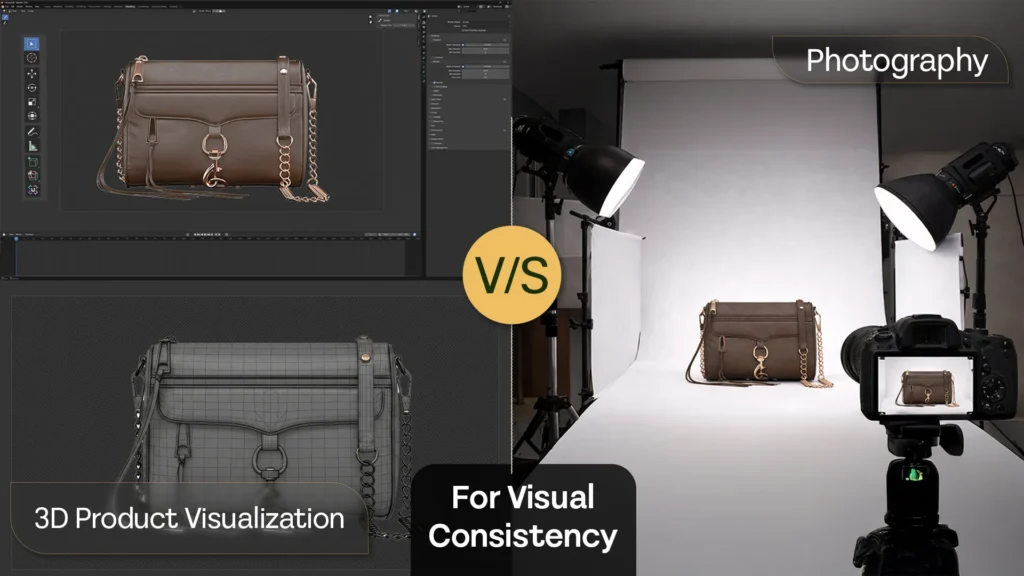
If you work with physical products, you’ve probably encountered this debate during a campaign kickoff or catalogue refresh: Do we set up a photoshoot, or do we build 3D models and render the visuals digitally?
Which one will give us more consistency across all our channels, 3D visuals or photography?
On the surface, it seems like a creative call. But in practice, it’s an operational one. This decision shapes your production timelines, controls how much you spend per SKU, determines how quickly new products reach the market, and dictates whether your visuals can be reused consistently across e-commerce, print, social, and retail touchpoints.
As product ranges expand and marketing channels multiply, choosing between 3D product visualization and photography has become less about aesthetic preference and more about scalability and control.
What’s important to understand is that this isn’t a win-lose debate. Photography hasn’t become obsolete, and 3D hasn’t replaced it entirely. Instead, most brands today use both deliberately, depending on what they’re trying to achieve.
To understand when & why, let’s dive deep into how these two approaches actually work in production environments.
What is Product Photography?
Product photography is the process of capturing physical products using cameras, C1 controlled lighting, and staged environments to create images for commercial use. It involves a setup including lighting rigs and backdrops, shooting the product from required angles, and then retouching the images to meet brand specifications.
For many brands, especially those selling tactile or organic products like food, textiles, leather goods, or cosmetics, photography captures a realism that’s difficult to replicate digitally.
Photography is particularly effective when:
- The product’s material quality is required to be captured as it is
- Subtle imperfections or natural textures are part of the appeal
- Lifestyle or environmental context is essential
- The product doesn’t change frequently
A well-shot photograph communicates authenticity in a way that feels emotionally grounded and looks premium.
However, photography also comes with limitations that aren’t always obvious at first.
Where Photography Hits Operational Limits
The challenge with photography isn’t the output; it’s the repeatability. If a product changes even slightly, a new colourway, updated packaging, a revised label, and getting a matching image often means coordinating another shoot. That means re-booking the studio, re-sourcing samples, re-aligning with the photographer’s availability, and rematching lighting conditions to maintain visual consistency with existing assets. What sounds like a minor update can quickly become a logistical effort.
For brands managing large catalogues, think 500+ SKUs or those with frequent product refreshes (seasonal packaging, regional variants, limited editions), this adds up. Each new variant multiplies cost, extends timelines, and increases the risk of visual inconsistency across your product library.
This is precisely the constraint that’s driven many brands to explore an alternative approach, 3D product visualization where the product exists as a digital asset that can be updated, re-rendered, and scaled without returning to a physical set.
What is 3D Product Visualization?
3D product visualization is often misunderstood as an alternative to photography. But in reality, it’s a production method to visualise the exact image of a product in 3D with the exact texture, lighting, and dimensions as the real one.
The process begins with 3D product modelling, in which a product is recreated digitally using accurate dimensions, materials, and surface properties. Once the model exists, it can be rendered into high-quality images using controlled digital lighting and camera settings, a process known as 3D product rendering
The result is a visual asset that behaves differently from a photograph:
- Lighting can be adjusted without reshooting
- Camera angles can be changed instantly
- Materials and colours can be swapped without rebuilding the product
- The same asset can be reused across multiple formats
This is where 3D asset visualization becomes a powerful and reliable option for businesses. Instead of creating a new image every time, brands create a reusable visual foundation, which is cost-effective and works across all touchpoints, maintaining visual consistency.
This approach works best for explaining complex products visually, particularly when products involve regular modifications, numerous colour options, or are in the initial stages of development.
Importantly, modern 3D product visualization isn’t about “looking digital.” When done properly, it can be used widely for different product ranges and look more consistent across all platforms.
The Cost Breakdown of Photography & 3D Product Visualization
Budget often drives the decision, but it’s frequently evaluated the wrong way. Most brands compare the cost of a single photoshoot against a single 3D model and assume photography is cheaper. In reality, the economics work in the opposite direction.
Why photography carries higher upfront costs
Traditional product photography involves a significant fixed cost structure before a single image is captured. Industry research across 100+ studios globally found that the total cost of a photoshoot breaks down roughly as:
- 40% goes to the photographer and studio hire
- 60% goes to everything else product transportation and shipping, lighting and equipment setup, props and styling for lifestyle scenes, and post-production retouching
Why 3D costs differently
3D product visualization front-loads the investment into building the digital asset modelling, texturing, and lighting setup. But once that asset exists, the marginal cost of changes drops dramatically:
- New colour or material variant: Update the texture file and re-render. No new samples, no reshoot. Typically, it adds only 15-20% to the original asset cost.
- Additional angles: Processing time, not production time. Near-zero incremental cost.
- Packaging or label update: Swap the decal on the model, re-render. Minutes, not days.
- New campaign or channel: Same asset, new outputs, no rebuild required.
- Lifestyle scenes: Once created, 3D environments and props can be rearranged and reused across products and campaigns indefinitely.
The principle is simple: create once, reuse endlessly.
For a product with multiple variants deployed across e-commerce, marketplaces, print catalogues, and sales tools, 3D visualization doesn’t just match photography’s output; it delivers more output at a fraction of the ongoing cost.
When each investment makes sense
Photography is worth the investment when:
- Your catalogue is small (under 20 SKUs) and stable minimal variants, infrequent updates
- You need lifestyle imagery with real human interaction, authentic environments, or organic unpredictability
- Your products have tactile or artisan qualities difficult to replicate digitally, food, handcrafted goods, and natural materials
- You’re producing one-time campaign assets unlikely to be reused or adapted
3D visualization is worth the investment when:
- Your catalogue has high (50+) SKU counts or frequent variant additions (colour, size, configuration)
- You need visual consistency across omnichannel touchpoints, including the web, app, marketplace, print, and retail
- Your products are still in development, and physical samples aren’t available yet
- You require interactive experiences like 3D configurator, 360° viewers, or mixed reality.
- You anticipate ongoing reuse of assets across campaigns, regions, or sales tools
For a single product with no variants and limited distribution, photography may still be the pragmatic choice. But for brands operating at scale or planning to make 3D shifts from a creative option to an operational advantage.
How to Pick the Right Visual Strategy for Your Brand
By now, the distinction should be clear: photography and 3D visualization aren’t competing technologies; they’re different tools suited to different operational realities. The question isn’t which one is “better” in the abstract. It’s which one is better for your specific situation, like your product type, catalogue structure, update frequency, channel mix, and internal capabilities.
What follows are two practical frameworks, one for when 3D visualization becomes the stronger choice, and one for when photography remains the better path.
Where 3D Product Visualization becomes the better Choice
Photography requires the product to exist. That’s a simple constraint, but a powerful one.
In many industries, marketing teams are expected to launch assets before manufacturing is complete. Packaging may still be in development. Final colours might not be locked. Prototypes may be limited.
This is where 3D product visualization becomes strategically valuable. Brands can begin marketing:
- Before production is finalized
- While engineering is still iterating
- Without waiting for physical samples
This parallel workflow shortens launch timelines and reduces pressure on production teams. For industries like consumer electronics, industrial equipment, furniture, or automotive components, this is a must-have and a standard practice.
Where Photography Remains the Better Choice
Despite all this, photography still plays a critical role.
When products rely on:
- emotional storytelling
- human interaction
- real environments
- organic variation
Photography communicates something that 3D intentionally removes unpredictability.
A lifestyle image with people using a product, light falling naturally, and imperfect surroundings often feels more relatable and people more resonate with it. For campaigns that aim to connect emotionally rather than explain function, photography still leads.
This is why the most effective brands don’t replace photography with 3D; they assign each to the right job.
The strategic balance
This is why the most effective brands don’t treat this as a replacement decision. They assign each method to the job it does best:
Use 3D for
Product catalogue and e-commerce images
Variant generation (colours, configurations)
Technical and explainer visuals
Configurator, AR, and interactive tools
Pre-production visuals before samples exist
Use Photography for
Lifestyle and editorial campaigns
Human interaction and product-inuse
Brand storytelling and emotional content
Social proof and influencer content
Organic/artisan product texture
The Role of Creative Agencies in This Decision
The real value of a creative agency isn’t choosing sides. It’s helping brands design a system that fulfils the brand’s visual requirements and maintains visual consistency across touchpoints.
The system answers questions like:
- Which products justify a 3D investment?
- Where does photography add real value?
- How can assets be reused across teams and regions?
- How do we avoid rebuilding visuals every year?
Eilan Digital understands that both photography and 3D product visualization can guide brands toward decisions that save time, reduce waste, and improve output quality, not just create good-looking images.
The question isn’t whether 3D product visualization is better than photography.
The real question is whether your current visual process is built for how your business operates today and how it will operate tomorrow.
Brands that understand this don’t argue about tools. They use them intentionally. And that’s where better visuals and better business decisions begin.
At Eilan Digital, we have years of experience in 3D visualization and photography. If you are looking for a reliable partner to develop these. Let’s connect and discuss your product requirements.
Previous
Let’s talk about what
you’re building.
Whether you’re refining a brand, preparing a market launch,
or bringing clarity to a complex product, we help translate
intent into structured, effective execution.