
Understanding the Difference Between Animation and Visual Effects for Smarter Video Production
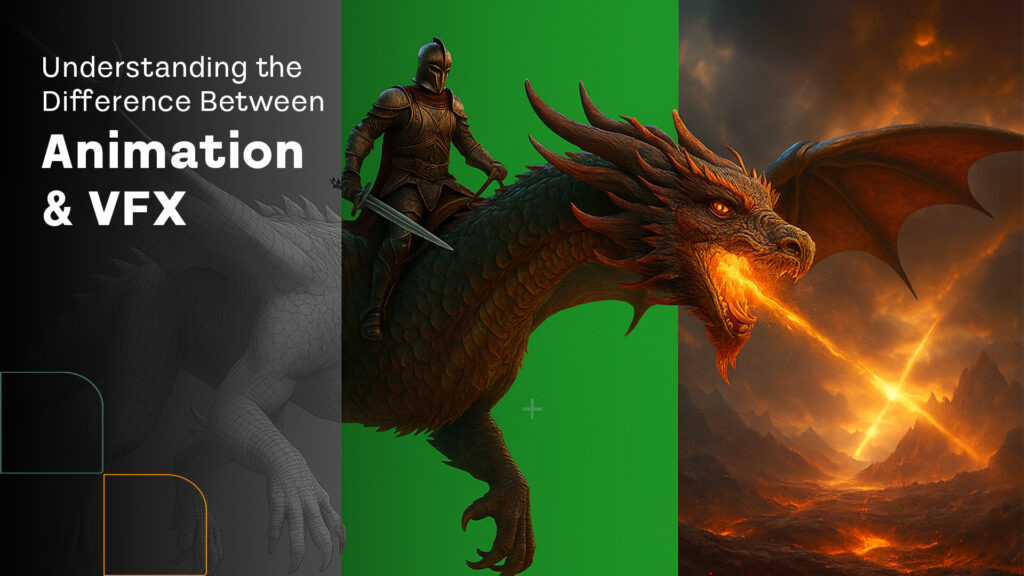
Two videos. Same script. Same budget. One uses animation, the other visual effects. Yet one grabs attention, and the other gets skipped in seconds. Why?
In today’s digital-first world, brands are increasingly relying on video to tell stories, showcase products, and build emotional connections with their audiences. Yet, when marketers plan a new campaign, one recurring question often arises:
Should we use animation or visual effects?
The difference between animation and visual effects may seem subtle, but understanding it can significantly impact how a brand approaches storytelling, budgeting, and overall video strategy.
Both animation and VFX (visual effects) have become essential tools in modern video production. They transform ideas into compelling visuals, from fully animated explainer videos to cinematic product launches. But the way each technique is used, and the kind of results it produces, are very different.
Let’s explore how animation and VFX work, their business applications, and how to decide which one fits your brand’s creative goals.
What Do You Understand by Animation in Modern Video Production?
To understand the difference between animation and visual effects, let’s begin with animation itself.
Animation is the art of bringing static visuals, drawings, objects, or 3D models to life through motion. It’s not bound by physical constraints, locations, or camera setups. Instead, everything from characters to environments is created digitally.
When someone asks, “What do you understand by animation?” the simplest answer is: animation creates movement where none exists.
There are several types of animation commonly used in business communication:
- 2D Animation: Flat graphics and vector illustrations, often used in explainer and marketing videos.
- 3D Animation: Adds realism and depth, ideal for product animation videos or architectural visualization.
- Motion Graphics: Focused on animated typography and shapes, perfect for brand storytelling and advertisements.
- Stop Motion: A niche but creative method that uses photographed objects to create motion.
Each of these techniques plays a distinct role depending on the communication goal.
What Are the Common Uses of Animation in Business Communication?
Animation has become a powerful business tool. Its flexibility and cost-effectiveness make it ideal for multiple communication needs.
1. Product Animation Videos
A product animation video is one of the most effective ways to demonstrate a product’s features, components, or mechanisms. It allows marketers to show every detail, even what can’t be filmed, like internal parts or processes.
For example, in the manufacturing or tech sector, 3D product animation can visualize how machinery works or how a circuit board connects internally. This is information that would otherwise be impossible to show clearly through traditional videography.
2. Business Animation for Explainers and Branding
Business animation videos simplify complex ideas, making them perfect for service-based industries like finance, SaaS, healthcare, or logistics.
For instance, a SaaS company can use motion graphics to explain how its platform automates workflows, while a healthcare brand might visualize patient journeys or treatment processes in an easy-to-understand way.
Animation also supports brand identity. Consistent visual styles, colors, and motion behavior strengthen brand recall and create emotional resonance.
3. Marketing, Education, and Internal Training
Animated visuals are excellent for educational content, training programs, and e-learning modules. They make abstract or technical subjects more digestible and engaging.
For example, a manufacturing company can train employees on safety procedures using animated simulations, or a university can turn complex theories into short explainer animations.
In marketing, short animations or motion graphic ads perform extremely well on social media. They’re quick to produce, cost-effective, and adaptable across platforms.
Overall, the uses of animation extend far beyond entertainment. For businesses, it’s a strategic communication tool that simplifies, informs, and persuades.
4. What Is VFX Animation and How Does It Differ from CGI?
Now that we’ve explored animation, let’s look at the second half of the equation: VFX (Visual Effects)
VFX (Visual Effects) refers to digitally altering or enhancing live-action footage. It’s used to add elements that can’t be captured on camera, like fire, explosions, environments, or futuristic objects.
CGI (Computer Generated Imagery), on the other hand, is the creation of these digital elements themselves, the 3D models, textures, or environments.
So, while CGI is the raw creation, VFX is the integration, blending CGI into live footage to make the scene believable.
Here’s the distinction at a glance:
| Aspect | Animation | VFX (Visual Effects) |
|---|---|---|
Source | Entirely computer-created | Enhances real-life footage |
Use Case |
Explainers, product demos, brand stories |
Cinematic ads, product films, live-action videos |
Example |
A 3D animated car ad |
A live-action car driving through a digitally created city |
Creative Control |
Full |
Partial (depends on footage) |
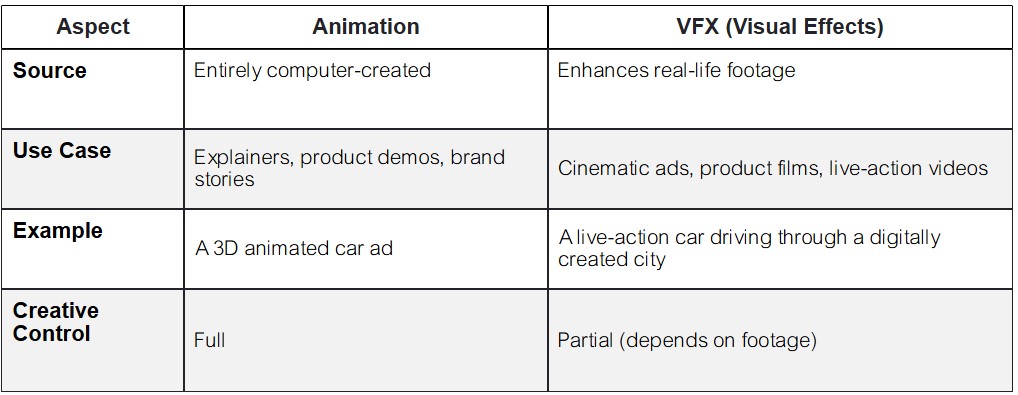
VFX and CGI often work together; CGI builds the asset, and VFX integrates it into the scene. This distinction is crucial for marketers deciding on the kind of production approach to take.
How Are Animation and Visual Effects Used Together in Product and Brand Videos?
The difference between animation and visual effects isn’t always about choosing one over the other; many successful brand videos use both.
For example:
- A product animation video may show how a product works internally, and VFX might enhance that same product in a live-action demo.
- A business animation could start with a stylised animated explainer and transition into a VFX-driven cinematic sequence for brand impact.
Animation helps convey clarity, while VFX adds realism and cinematic emotion. Together, they deliver storytelling depth that neither technique could achieve alone.
How Is Animation Production Structured for Videos?
Understanding how animation production works helps business owners estimate timelines, costs, and creative flexibility.
Animation Production Process
- Concept Development – Defining message, style, and audience.
- Storyboarding – Sketching visual flow and transitions.
- Design & Asset Creation – Building characters, products, or scenes.
- Animation & Motion – Bringing static visuals to life.
- Rendering & Compositing – Final lighting, texturing, and assembly.
This process gives marketers complete control; every element can be aligned with brand guidelines, from colors to camera angles. Unlike live shoots, animation avoids reshoots or environmental limitations. Once assets are created, they can be reused in new campaigns, saving costs over time.
How Do VFX Services Work in Professional Video Production?
VFX services come into play when a project involves live-action footage that needs enhancement or integration.
The process typically includes:
- Pre-visualization and Planning – Mapping out what will be filmed versus created digitally.
- Shooting with Tracking – Capturing live footage with camera data for accurate integration.
- Compositing – Combining real and digital footage seamlessly.
- Simulation & Effects – Adding physics-based elements like smoke, light, or reflections.
- Color Grading & Post-Production – Ensuring a unified, cinematic look
For businesses creating promotional films, VFX animation is what gives live-action storytelling its “wow” factor. It turns ordinary shots into extraordinary brand experiences.
What is the Role of AI in Animation and VFX?
The rise of AI in animation and VFX services is revolutionising how creative agencies produce videos. AI tools can now generate realistic environments, assist in character rigging, and automate tedious post-production tasks.
Key AI Applications
- Pre-Visualization : AI can automatically build camera movements and lighting setups Sketching visual flow and transitions.
- Design & Asset Creation: AI assists animators with in-between frames, reducing rendering time.
- Rotoscoping in VFX: help isolate moving elements, speeding up compositing.AI tools
- Asset Generation: Text-to-image models produce concept art and background visuals in minutes.
For businesses, this means faster turnaround times, reduced costs, and more iterations possible within the same budget. AI doesn’t replace human creativity; it amplifies it.
How to Choose Between Animation and VFX for Your Next Video Project
Choosing between animation and visual effects depends on your goal, audience, and message clarity. Here’s a framework for decision-making:
| Question | Go with Animation | Go with VFX |
|---|---|---|
What’s your primary objective? | To explain or simplify a concept | To impress or emotionally engage |
Do you have existing live footage? |
Not necessary |
Essential |
Budget flexibility? |
More scalable |
Depends on shoot complexity |
Timeline? |
Faster and reusable |
Longer, due to post-production |
Brand style? |
Clean, illustrative, informative | Content |
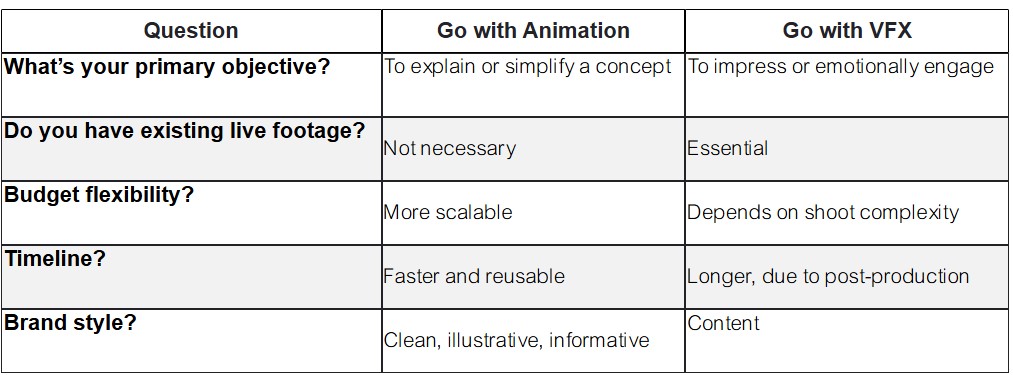
Many marketing managers blend both: using animation for education and VFX for emotion.
A good rule of thumb is that if your story is conceptual or instructional, go with animation. If it’s visual or cinematic, go with VFX.
How Businesses Benefit by Understanding This Difference
Knowing the difference between animation and visual effects enables smarter investment decisions. It helps brands:
- Budget realistically based on production needs.
- Match storytelling style with audience expectations.
- Repurpose content across digital channels.
Moreover, this understanding improves collaboration with creative agencies, ensuring goals, timelines, and deliverables align clearly from the start.
A Creative Agency’s Perspective: How Eilan Digital Bridges Animation and VFX
As a creative and digital agency, Eilan Digital understands that storytelling today demands a seamless blend of art and technology. Whether it’s a product animation video, a motion graphics campaign, or a cinematic brand film enhanced by VFX and CGI, the goal is always the same: to make brands visually memorable and strategically effective.
Eilan Digital’s approach focuses on clarity, design precision, and visual storytelling that aligns with business goals. The agency collaborates with clients to define whether animation, VFX, or a hybrid workflow serves the brand’s purpose best, balancing creativity with commercial impact.
By integrating AI-assisted workflows and efficient animation production pipelines, Eilan Digital helps brands communicate smarter and stand out in competitive digital spaces.
Why the Difference Between Animation and Visual Effects Matters for Marketing Leaders
For marketing managers and business owners, the choice between animation and visual effects is not just about aesthetics; it’s a strategic decision.
Animation simplifies ideas and improves comprehension. VFX enhances realism and drives emotional impact. Together, they create memorable brand experiences that cut through digital noise.
In a world saturated with video content, those who understand the difference between animation and visual effects gain a real edge. They can plan smarter campaigns, allocate budgets wisely, and produce content that connects deeply with their audience.
Want your next brand video to do more than just look good?
Partner with Eilan Digital, a creative and digital agency. We merge animation, VFX, and brand storytelling to help businesses create content that inspires and converts.
👉 Let’s talk about your next campaign.
FAQs
Q. What is the difference between animation and visual effects (VFX)?
A. Animation involves creating visuals entirely from scratch, using design, modeling, and motion to bring static elements to life.
Visual effects (VFX), on the other hand, blend digital elements with live-action footage to enhance or alter what’s been filmed. Animation builds worlds; VFX enhances reality.
Q. When should a business use animation instead of VFX?
A. Use animation when your story or product doesn’t need real-world footage. For example, product animation videos, explainer videos, or educational content.
Q. Is AI changing animation and VFX production?
A. Yes, AI tools are now automating tasks like rotoscoping, motion tracking, and asset generation, making animation production faster and more cost-efficient. However, human creativity remains central for storytelling and brand alignment.
Q. How do animation and VFX work together in a brand film?
A. Live-action shots of a product can be enhanced with VFX and CGI, while animated overlays or transitions explain its features dynamically.
Q. How long does animation production take?
A. The timeline depends on complexity, style, and length. A simple 2D explainer might take 2–3 weeks, while a high-detail 3D product animation can take 6–8 weeks.
Previous
Let’s talk about what
you’re building.
Whether you’re refining a brand, preparing a market launch,
or bringing clarity to a complex product, we help translate
intent into structured, effective execution.