
How 3D Visualisation Enhances Manufacturing Efficiency
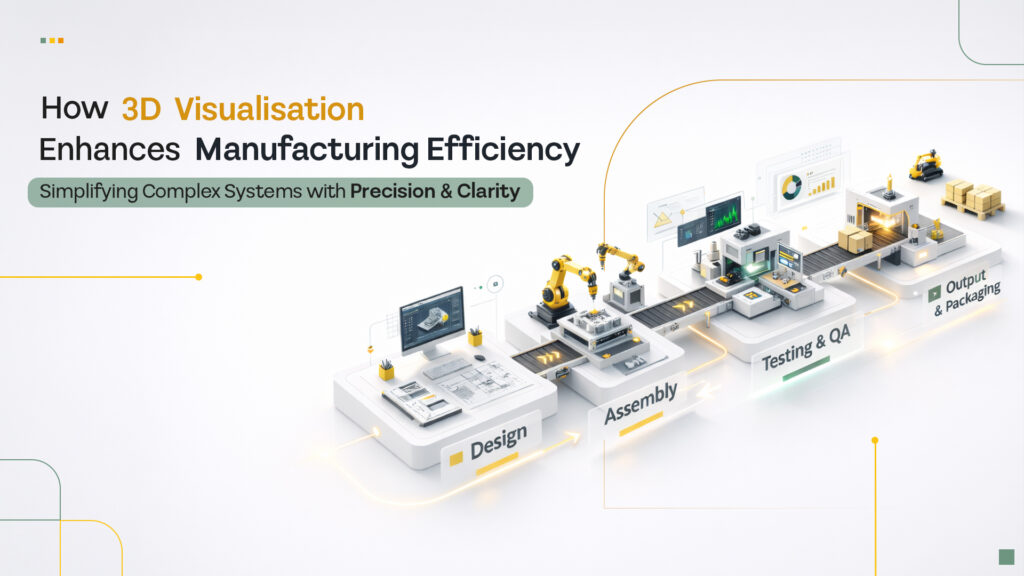
Manufacturing products are not simple. They involve intricate engineering, precise tolerances, multiple configurations, and layered assembly processes that no brochure can adequately communicate. 3D visualisation helps exactly to remove this complexity.
Whether you manufacture heavy machinery, industrial equipment, precision components, or consumer-facing products, every detail can be modelled, animated, and made explorable.
Today, manufacturing companies run fast with innovation and accuracy from product design to final assembly; even a minor error can lead to significant financial losses.
Rework on complex machinery, pharmaceutical packaging such as medicine blisters, or industrial products like water pumps can cost manufacturers millions in wasted materials, time, and operational delays.
Modern manufacturing systems involve machines with numerous interconnected components and highly specific performance requirements. Visualising how these parts interact and function within a complete system can be challenging when relying only on drawings or photographs.
With the rapid integration of digital technologies into industrial processes, 3D product visualisation services have become an effective tool for simplifying complex systems and improving clarity across different stages of manufacturing.
From concept development to training and marketing, it allows manufacturers to present products and processes with greater accuracy. In this blog, we will explore how 3D visualisation enhances efficiency across key areas of the manufacturing workflow.
How 3D Visualization Improves Product Manufacturing
1. Concept Development and Product Ideation
At the early stages of product development, communicating complex engineering ideas using sketches or technical drawings can be difficult. Stakeholders, management teams, and even cross-functional teams may struggle to interpret how a concept will turn out into a real product.
3D visualisation allows engineers and designers to transform ideas into realistic visual models. These models help understand the product structure, evaluate design options, and provide quicker feedback during the ideation and prototyping phase.
As a result, manufacturers can validate concepts earlier with 3D visualisation and move forward with increased accuracy.
2. Prototyping and Design Validation
Creating physical prototypes is often expensive and time-consuming, especially for large industrial machinery. Design errors discovered during this stage can significantly increase project costs.
3D visualisation enables manufacturers to build virtual prototypes before producing physical models and analyse how the machines will work in the early stage.
Engineers can evaluate product form, structure, and how it will work in the environment, helping identify design issues early in the process. This reduces the number of physical prototypes required and accelerates design validation, ultimately saving both time and resources.
3. Engineering Communication and Collaboration
Manufacturing projects typically involve multiple teams, including design engineers, production specialists, quality control experts, and management. Miscommunication between departments can slow down projects and lead to errors during implementation.
3D visualisation improves collaboration by providing a clear and detailed representation of product assemblies and internal mechanisms.
Teams can review components, understand their interactions, and discuss modifications more effectively. This visual clarity supports faster decision-making and smoother coordination across departments.
4. Assembly Planning and Process Simulation
Industrial machines often consist of hundreds or even thousands of components and parts. Planning the correct sequence for assembling these parts is essential to maintaining efficiency on the production floor.
Using 3D visualisation, manufacturers can simulate assembly processes before production begins, minimising clashes and impractical assembly.
At this stage, 3D visualisation step-by-step visual demonstrations help identify potential challenges, optimise assembly workflows, and ensure that each component fits correctly within the system.
This preparation reduces errors during manufacturing and improves overall productivity.
5. Technical Training and Maintenance
Operating and maintaining complex machinery requires clear technical guidance. Traditional manuals and static diagrams often fail to explain intricate internal components and to understand how to operate a machine effectively.
3D visualisation enables the creation of animated training materials and interactive maintenance guides, helping learn faster and retain the information better than static diagrams.
These visual resources illustrate assembly procedures, disassembly processes, and component functions with greater clarity. As a result, technicians and operators can understand equipment more easily, improving training efficiency and reducing maintenance errors.
6. Product Demonstration and Industrial Marketing
Beyond engineering and production, manufacturers must also communicate product capabilities to potential buyers and distributors.
Demonstrating complex machinery with photographs does not justify its complex mechanism, or physical samples can be limiting to move each time you want to show.
3D visualisation allows companies to present products through exploded views, mechanism animations, and detailed digital demonstrations. These visual assets help potential buyers understand how a product works, even without seeing it physically. This approach enhances product presentations, website content, and trade show demonstrations.
How 3D Visualisation Enhances Your Presence at Exhibition
Trade shows and exhibitions are where deals are made, partnerships are forged, and first impressions become lasting ones. But when your products are large, complex, or technically intricate, getting prospects to truly understand what you offer has always been the hardest challenge in the room. 3D product visualisation changes that completely.
Shipping physical machinery or full-scale equipment to a trade show is expensive, impractical, and impossible.
Static brochures and printed catalogues fail to capture moving parts, internal mechanisms, or the true scale of your engineering. Sales reps spend their time explaining rather than selling, and prospects leave with questions instead of confidence. Here are the benefits it presents:
- Explode every component: It makes it easy to walk prospects through internal assemblies, moving parts, and hidden mechanisms with interactive 3D exploded views.
- Depth of information on demand: Each component carries technical specs, materials, tolerances, and features, surfaced instantly when a buyer needs them.
- Easy to carry your whole product line: The entire product line can be stored in a single USB, making it easier to carry.
- Photorealistic demonstrations: Show your products operating in real-world environments with material finishes, lighting, and motion that feel indistinguishable from the physical product.
- Real-time product configuration: Let buyers customize and configure products live on the show floor, choosing specs, variants, and options while watching the 3D model update in real time.
- Closer buyer engagement: Interactive 3D models keep prospects at your booth longer, create natural conversation, and build the confidence that drives purchase decisions faster.
The advantages of 3D visualisation are clear. But realising those advantages depends entirely on working with a partner who understands the manufacturing world, not just the design software.
With years of hands-on experience working alongside manufacturing companies across industries, Eilan Digital has helped some of the sector’s biggest names bring their products to three dimensions. As a creative and digital agency, we understand the weight of getting technical details right, the importance of visual storytelling at exhibitions, and the business outcomes that great 3D visualisation actually delivers.
Our team works with you from concept to final output, ensuring every component, every material, and every interaction is crafted to represent your product with the precision it deserves. Schedule a free consultation today.
To sum up
As manufacturing systems continue to grow more complex, the need for clearer communication and efficient workflows becomes increasingly important. 3D visualisation provides manufacturers with a powerful way to understand, present, and optimise products throughout the entire production lifecycle.
From concept development and prototyping to assembly planning, training, and marketing, 3D visualisation improves clarity, reduces costly errors, and supports faster decision-making. By integrating this technology into their workflows, manufacturers can enhance efficiency, minimise risk, and streamline the journey from product idea to final execution.
Previous
Let’s talk about what
you’re building.
Whether you’re refining a brand, preparing a market launch,
or bringing clarity to a complex product, we help translate
intent into structured, effective execution.