
How B2B Explainer Videos Are Used Across Sales, Marketing, and Investor Pitches
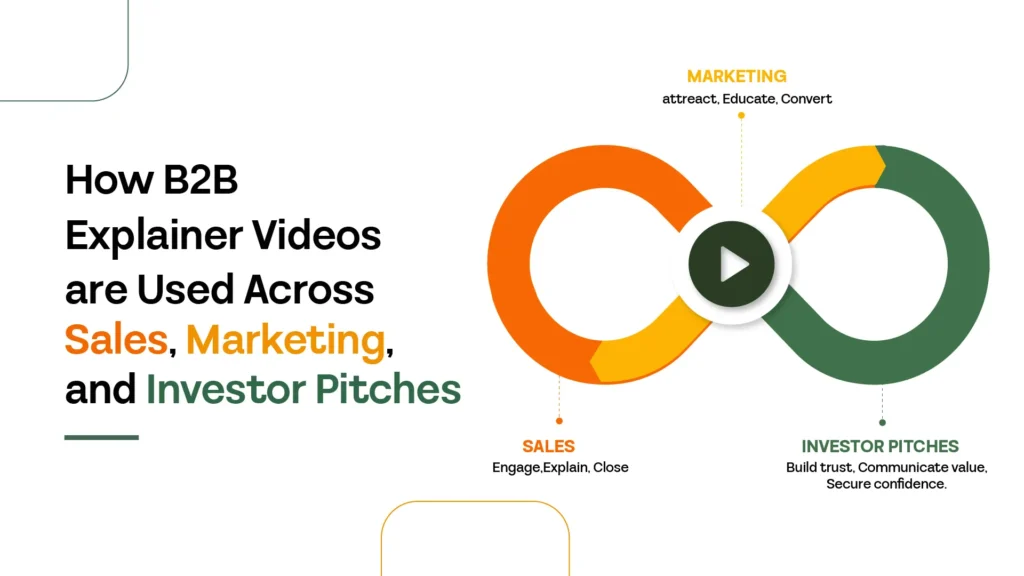
Most B2B companies discover the same problem at some point. The product works. The team believes in it. But somewhere between what you know and what your audience understands, people get lost. A well-structured B2B explainer video exists precisely to close that gap.
Prospects nod through demos without fully grasping the offer. Landing pages generate traffic but not decisions. Investors ask follow-up questions that suggest they missed the point entirely.
The product is not the problem. The communication is.
B2B explainer videos are not a marketing trend or a box to tick because competitors have them. They solve a specific challenge: complex products require structured communication, and most businesses rely on formats that were never designed to deliver it clearly or quickly.
This article examines how B2B companies actually use explainer videos across sales, marketing, investor relations, and product onboarding, and what separates the ones that generate measurable results from the ones that simply exist on a website.
What Are B2B Explainer Videos?
A B2B explainer video is a short, purposefully structured video designed to communicate a product, service, or concept to a professional audience. The typical length sits between 60 and 180 seconds. The format can be animated, live-action, screen-recorded, or a combination, but the format is a secondary consideration.
What defines an explainer video is its intent: to make something genuinely difficult to understand feel immediately clear.
The distinction matters because companies often confuse explainer videos with product demos or brand videos. A brand video builds emotional association. A product demo walks through functionality.
An explainer video answers the prior question: why does this exist, who is it for, and what does it actually change about how that person works? That upstream clarity is what makes every other piece of content perform better.
Why B2B Companies Rely on Them
The case for explainer videos in a B2B context comes down to three things: cognitive load, attention, and trust.
Cognitive load refers to the mental effort a person has to expend to understand something. When that effort is high, comprehension drops, and so does confidence in the product being described.
A buyer who has to work hard to understand your offer will almost always interpret that friction as product complexity rather than communication failure. The result is hesitation, and in a competitive category, hesitation is a closed door.
Well-constructed explainer videos reduce cognitive load by sequencing information deliberately. They lead with a problem the viewer already recognises, build context around why it exists, and introduce the solution once the viewer has a frame to place it in. That structure is not an aesthetic choice. It is how the brain accepts and retains new information.
Attention works differently in a B2B context than most marketers assume. The average buyer in a considered purchase is not disengaged. They are extremely busy and ruthlessly prioritising. A B2B explainer video does not succeed by being entertaining. It succeeds by making the value of continued attention obvious in the first ten seconds. Viewers stay because they see something relevant, not because the animation is impressive.
Trust is the least discussed but most consequential dimension. A polished, logically coherent explainer video communicates something about the company before the content does. It says that the team understands the buyer’s world well enough to describe it accurately. That perception shapes the sales conversation that follows.
How Sales Teams Use B2B Explainer Videos
Sales teams have adopted B2B explainer videos most aggressively, and for practical reasons. The average B2B sale involves six to ten stakeholders. The rep speaks directly to maybe two of them. Everyone else forms their opinion from materials that travel through the organisation without a salesperson attached.
Before a discovery call, sending a short explainer video reframes the meeting entirely. Instead of spending the opening fifteen minutes on company background, the rep arrives at a conversation already positioned. The video has handled the “what is this” question, which means the meeting can focus on the buyer’s specific situation.
During longer sales cycles, explainer videos serve a different function. When a prospect’s internal champion needs to make the case to finance, legal, or a senior executive, they need something that communicates clearly without them in the room to contextualise it. A sales explainer video is collateral designed to travel. It makes the argument correctly every time, to every stakeholder, regardless of whether the original rep is present.
The measurable impact is consistent. Outreach sequences that include video see higher reply rates than text-only approaches. Proposals that include a supporting video are opened more frequently and receive faster responses. These are not marginal improvements. For sales teams managing large pipelines, the cumulative effect on cycle length and win rate is significant. Video is most effective when it sits inside a broader B2B digital marketing strategy rather than operating as a standalone asset.
How Marketing Teams Deploy Explainer Videos Across the Funnel
Marketing teams derive the most value from explainer videos when they treat them as infrastructure rather than individual pieces of content. A single well-made explainer video can anchor an entire content ecosystem, serving different functions depending on where and how it appears.
At the top of the funnel, an explainer video on a homepage or paid landing page performs a qualification function as much as a conversion function. Visitors who watch more than sixty per cent of an explainer video are self-selecting as genuinely interested. That behavioural signal is far more reliable than time-on-page or scroll depth. It also means that the leads who do convert tend to be better qualified, which improves downstream sales efficiency.
At the consideration stage, more specific videos tied to particular use cases or buyer personas address the “but does it work for us?” question that stalls mid-funnel deals. These are not the same video repurposed. They are separate arguments made to a more informed audience. The difference between a top-of-funnel explainer and a mid-funnel one is the level of assumed knowledge and the specificity of the value claim.
In nurture sequences, short video content consistently outperforms text-based emails on click-through rate and downstream conversion. The reason is partly format preference and partly framing. Receiving a video feels like being sent something of value. Receiving another email with a link to an article feels like being managed.
For SEO, explainer videos embedded on target pages increase average time on page, reduce bounce rate, and improve the overall quality signal to search engines. Video content also earns featured placement in search results, which increases click-through rates independent of ranking position.
How Founders Use Explainer Videos in Investor Pitches
Fundraising is a communication problem before it is a financial one. Investors make early decisions based on how clearly a founder understands the problem they are solving, the market they are entering, and their own differentiation. Clarity of thought is the proxy for execution credibility at pre-revenue or early-revenue stages.
An explainer video embedded in a pitch deck or sent alongside an intro email solves a specific challenge: it shows the investor what the product does without requiring a full demo. For companies building in complex technical categories, fintech, infrastructure, deep tech, or enterprise SaaS, the ability to control the level of abstraction is valuable. The video can convey the mechanism without losing the audience in implementation details.
There is also an async fundraising dimension that has grown significantly. Warm intros are often followed by a brief message and a deck. Including a two-minute explainer video in that package, one that clearly articulates the problem, the solution, the market size, and the team’s specific angle, substantially increases the likelihood of getting a meeting. Investors reviewing twenty decks in an evening will remember the ones that required the least effort to understand.
The strategic requirement for investor explainers differs from marketing or sales videos. The argument structure prioritises credibility and market logic over emotional resonance. The visual execution still needs to be professional, but the script needs to demonstrate analytical rigour. Founders who make investor explainers that read like marketing content tend to find that the format works against them rather than for them.
Why SaaS Companies Depend on Them
SaaS products face a specific communication challenge that most other categories do not. The product exists in software. Until a user is inside it, the experience is entirely abstract. Screenshots are static. Feature lists are forgettable. Long-form content requires an investment most buyers are not yet ready to make.
An explainer video solves the abstraction problem by showing the product in motion, within the context of a problem the buyer already has. This is not the same as a product demo. A demo shows what the product can do. An explainer video shows why someone would care.
SaaS companies use explainer videos in onboarding to reduce time-to-value for new users. When a user understands the full scope of what a product can do before they have fully explored it themselves, activation rates increase and the ROI of explainer videos for SaaS compounds across onboarding, retention, and support.
The alternative, letting users discover value on their own through a product that may have a learning curve, results in churned trials and lost revenue.
For enterprise SaaS, explainer videos appear in sales decks, security review documents, procurement submissions, and implementation proposals. They are the one format that continues doing its job regardless of which stakeholder is reviewing the material.
What Makes a B2B Explainer Video Actually Effective
The production quality of an explainer video matters less than most buyers of explainer videos assume. What determines performance is the quality of the strategic thinking behind it. It is also worth noting that while AI video production tools have evolved rapidly, the strategic brief and script still require human judgment to work correctly for a B2B audience.
Effective explainer videos open with the buyer’s problem, not the product. This is not a stylistic preference. When a viewer sees their specific challenge described accurately in the first ten seconds, they become invested in what comes next. That psychological hook is the difference between a video that gets watched and one that gets skipped.
They also respect the information hierarchy. Every concept introduced in the video needs to be there for a reason. The script should be able to survive a question after every sentence: “Why does the viewer need to know this at this point?” Anything that cannot answer that question clearly should not be in the video.
Length deserves more strategic attention than it usually receives. The pressure to make a comprehensive video is understandable but consistently counterproductive. A ninety-second video that communicates one thing with absolute clarity will outperform a three-minute video that covers everything but commits to nothing. One video, one job.
The call to action at the end of the video needs to match the funnel stage the video is designed for. A video embedded in cold outreach should ask for a conversation, not a purchase. A video on a demo request page should confirm and direct. Misaligning the CTA with the viewer’s stage in the buying process is one of the most common and most avoidable mistakes in B2B video.
Common Mistakes That Cost Companies Results
The most prevalent mistake is not making a bad video. It is making a video with too many objectives. When a single video is expected to serve awareness, consideration, and conversion audiences simultaneously, it ends up serving none of them well.
Underfunding the script relative to the production is equally damaging. Most explainer video budgets are allocated primarily to animation or live-action production. Most of the commercial value comes from the strategic clarity of the script. A sharp script with modest production will consistently outperform a visually impressive video built around vague messaging.
Distributing a video without considering the context in which it will be watched is a frequently overlooked error. A video designed for homepage autoplay without audio cannot carry the same informational load as a video being watched in a scheduled meeting. The same content, distributed differently, will produce very different results.
Finally, measuring the wrong things. View count is a vanity metric for B2B video. Watch-through rate tells you whether the content is actually working. A video watched to eighty per cent completion by three hundred qualified buyers is worth more commercially than a video that accumulates ten thousand views from people who left after fifteen seconds.
Final Thoughts
B2B explainer videos, used with strategic intent, are among the most efficient communication investments a company can make. They do not replace sales conversations or marketing strategy. They make both of those things work better, faster, and across more stakeholders than the company can reach directly.
The businesses that see the strongest returns treat explainer video as a communication problem requiring strategic thinking, not a production problem requiring creative execution. The script, the audience, the funnel stage, and the distribution context all matter more than the animation style or the production budget.
Getting any one of those dimensions wrong means the video exists without doing the job it was supposed to do. Getting them right means a single piece of content can perform for years.
At Eilan Digital, we work with B2B companies and SaaS founders to build explainer videos designed around a strategic brief first and a creative execution second. If your business is navigating a complex sales cycle, a product launch, or a fundraise, and you want a video that does the communication work it is supposed to do, we would be glad to start a conversation.
FAQs
Previous
Let’s talk about what
you’re building.
Whether you’re refining a brand, preparing a market launch,
or bringing clarity to a complex product, we help translate
intent into structured, effective execution.