
What Is CGI Advertising and How Does It Work?
Campaign timelines are getting shorter, product lines are getting more complex, and content demands are growing across e‑commerce, social, and retail.
For modern brands, the real production challenge is no longer ‘Can we create great visuals?’ It is ‘Can we create great visuals, at scale, across markets, on time, and on budget?’
CGI advertising has emerged as a practical answer to that challenge. By building photorealistic digital twins of products and environments, CGI in advertising gives brands full control over lighting, angles, variations, and formats without the constraints of physical shoots.
This article breaks down what CGI advertising is, how it works in practice, the specific business problems it solves, and where it delivers the highest return for modern brands.
What is CGI in Advertising?
CGI (Computer Generated Imagery) is a technology that creates digital images or animations using 3D computer graphics. In marketing, it enables companies to produce realistic CGI visuals that showcase the products or services in any environment or lighting conditions.
A traditional photo shoot captures what already exists, under the constraints of real sets, lighting, and camera positions. CGI in advertising creates the ideal version of what could exist:
- The perfect hero shot.
- The impossible camera moves through a product’s interior.
- The precise reflection across a metallic surface at sunset.
- The same key visual, accurately adapted to 20 markets with different labels or pack claims.
That re-framing strategy of CGI provides tangible outcomes:
- Speed to market – Launch with full-funnel visuals while engineering and production finalize physical units.
- Reduced long-term production costs – One master 3D asset can power campaigns for years, across channels and markets.
- Content personalization and variation – Generate multiple colourways, bundles, or environment variations from the same base asset.
- Multi-channel agility – Use the same core asset for TV, OLV, social cut downs, e‑commerce detail shots, retail displays, and FOOH (Fake Out-of-Home).
How Does CGI Advertising Work
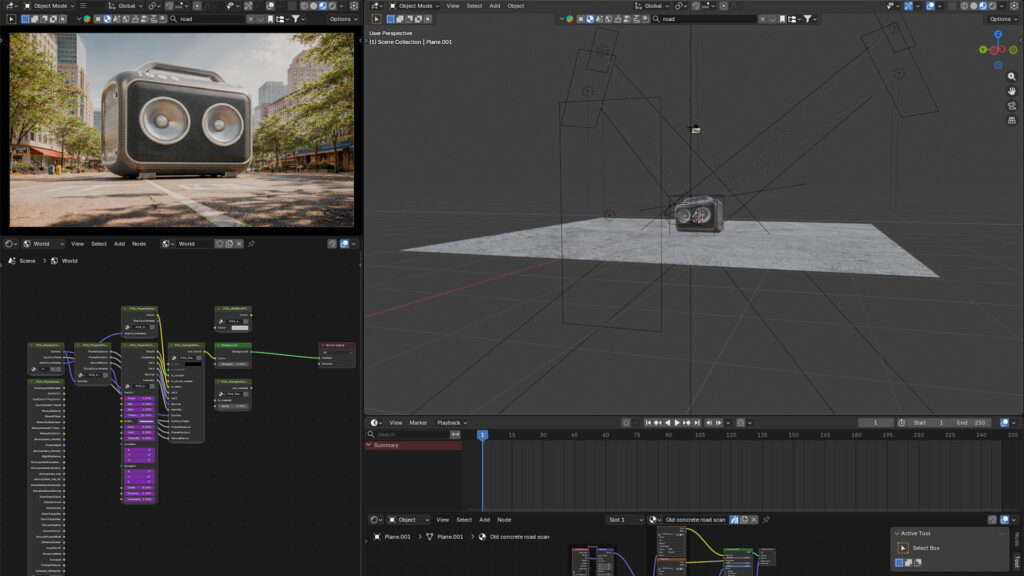
CGI advertising uses 3D computer graphics, animation, and special effects to create photorealistic or stylized visuals. We build a complete 3D scene product, environment, materials, lighting, and camera inside the software, then generate final images or videos from it.
The process unfolds through structured digital stages, from conceptualization to final rendering, enabling brands to depict products in surreal or impossible settings.
The High-Level CGI Pipeline
A typical CGI in a marketing project follows these stages:
1 . Pre-production & Scripting
2 . 3D Modelling
3 . Texturing & Materials
4 . Rigging & Animation
5 . Lighting & Rendering
6 . Compositing & Finishing
Challenges to Get Right
CGI is powerful, but the main task is to get the right strategy and approach
- Upfront investment is required to build high-quality assets and libraries
- Quality thresholds matter; poor lighting or materials break realism and trust
- Complex work still takes time, especially cinematic hero assets
- Asset governance is essential to prevent version drift and inconsistency
When these are managed well, CGI becomes a long-term advantage rather than a one-off execution.
Where CGI Advertising Delivers the Highest Impact
1 . Automotive & Mobility
Automotive brands face intense pressure to showcase models in every colour, trim, and environment before fleets exist.
- Photo-real digital vehicles with accurate paint finishes, interiors, and lighting, usable for hero films, configurator, and press materials.
- Day/night, seasonal, and geographic environments swapped instantly to suit markets and campaigns without costly location shoots.
Location shoots of automobiles are not only hard but costly as well. Imagine you want to shoot the vehicle in multiple locations, for example, on a snowy mountain road, a coastal highway at sunset, and a futuristic city. With CGI and chroma screen, the car can be filmed once in a controlled studio. The background, lighting, weather, and road conditions are then replaced digitally to create hyper-realistic environments.
In a single campaign, the same car can race through a storm, glide across desert dunes, and navigate a neon-lit city all without leaving the studio. This allows brands to advertise performance, safety, and lifestyle in ways that would be nearly impossible or unsafe to film in the real world.
Want to see how a CGI visual system could work for your product line?
Schedule a call to explore the possibilities
2 . Consumer Electronics & Technology
For devices, hardware, and connected products, CGI enables detail and control that photography struggles to match.
- Close-up hero shots of ports, textures, and interfaces that communicate quality and innovation.
- Exploded views and cutaways to tell product stories that are impossible to film physically.
3 . FMCG / CPG
In fast-moving categories, packaging, claims, and formats change frequently. Reshooting everything every time is not sustainable.
- Liquids and glass rendered to look consistently premium across hero assets, e‑commerce, and in-store.
- Packaging refreshes are handled by updating labels, colours, or claims on master packs, not rebuilding entire sets.
- Multiple SKUs from a single master asset, enabling rapid creation of new variants, bundles, and promo packs.
4 . Home, Furniture & Interior Brands
Physical room sets are costly, slow, and inflexible.
- Modular room scenes where decor, materials, and layouts can be swapped to match regional tastes.
- Configurable products (fabrics, finishes, sizes) visualized accurately across the web, catalogues, and retail displays.
- Seasonal styling (festive, summer, back-to-school) achieved by re-dressing digital scenes, not rebuilding sets.
These are just a few examples. The pattern is consistent where products are complex, variant-heavy, or global; CGI in marketing delivers outsized value.
Advantages of CGI Advertising
1 . Cost Efficiency
CGI can lower the cost. Once a master 3D asset is built, new colours, finishes, and SKUs are generated digitally eliminating repeated shoots, sets, and retouching.
Also, imagine an ad concept that requires a car in the mountains or in a desert. Travel, crew logistics, and equipment transportation would be expensive. Instead, this can be shot with chroma screen at low cost and high efficiency, making 3D product visualization cost-effective.
2 . Visualising Products Before They Exist
3 . Simplified Localisation and Market Adaptation
4 . Consistent Brand Presentation
Why CGI Advertising Is Rising Now
CGI (Computer Generated Imagery) is not new. What’s changed is how brands are using it as a foundational production capability.
Several structural shifts are driving this towards CGI in advertising:
- Shorter time-to-market
Product refreshes, seasonal editions, are marketable in their lifecycle. CGI allows you to create launch-ready visuals while products are still in development. - Digital first and e‑commerce-led growth
More launches are digital-only, like e‑commerce, D2C, marketplaces, and retail media. These environments demand consistent, high-resolution, adaptable visuals, something CGI is uniquely suited to deliver. - Always on content requirements
Brands need ongoing, platform-specific content across social, web, in-app, marketplaces, POS, and DOOH (Digital Out-of-Home). Re-shooting every angle, variant, and seasonal twist is not sustainable. 3D Environment & assets can be refreshed, re-lit, and re-framed endlessly. - Rising cost of traditional production
Physical shoots involve logistics, travel, sets, reshoots, and time. Over multiple campaigns, a structured CGI pipeline delivers a lower total cost of ownership, especially for brands with large portfolios.
In this context, CGI advertising is less about replacing photography and film and more about rebuilding the production foundation so marketing can move at business speed.
In a nutshell
CGI advertising is strategic marketing that is quickly becoming the most practical way for brands to keep up with the pace and complexity of modern marketing.
By turning products and environments into flexible 3D assets and chroma screen shoots, brands can explore more ideas, move faster, and show up consistently across every channel without being held back by shoot schedules or production costs.
For teams under pressure to do more with less, CGI in advertising isn’t just a creative upgrade, it’s a smarter way to plan, produce, and scale content that actually keeps up with the business.
We specialize in helping brands in strategic planning, designing, and operating CGI pipelines that are creatively ambitious, technically robust, and operationally reliable.
If you’re exploring how CGI could support your next major launch, or how CGI in marketing could reshape your broader content ecosystem, we’d be happy to talk.
Contact us, and we’ll map out where CGI can deliver the highest impact in your current and upcoming projects.
Previous
Let’s talk about what
you’re building.
Whether you’re refining a brand, preparing a market launch,
or bringing clarity to a complex product, we help translate
intent into structured, effective execution.