
When an Interactive 3D Model Justifies the Cost Over Product Video
In today’s customer-centric market, selling a product is no longer just about building it well. It’s about helping your customer truly understand it. Making a product clear and easy to grasp for the right audience is just as important as manufacturing it.
As digital experiences continue to evolve, customers expect information to be quicker, visual, and engaging. Most people don’t want to spend time reading long, text-heavy documents. This is where product videos come in. They clearly showcase features, appearance, and usage, making it easier for customers to connect with the product.
But what if your customer wants to explore the product more deeply? What if they want to look inside it, view it from every angle, or customize it to match their exact needs?
That’s where interactive 3D and configurator step in.
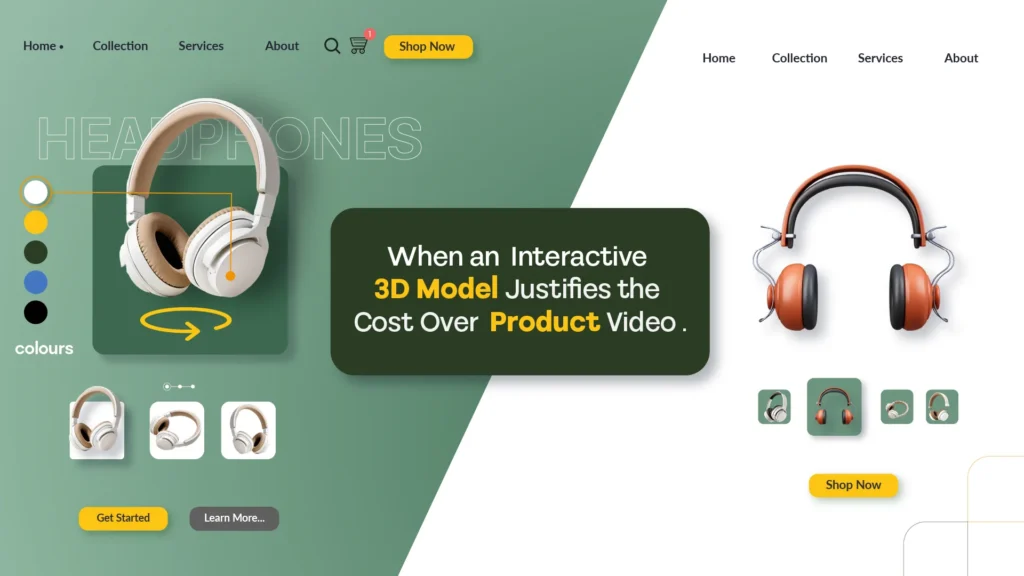
With interactive 3D visualization, customers can rotate, zoom, spin, and inspect a product in detail. They can change colors, materials, patterns, or components and instantly see how the final product will look. It transforms passive viewing into an engaging, hands-on experience.
There’s no denying it 3D configurator can create a powerful impact for your business. But they also require a significant investment.
So the real question is, should you invest in it? And more importantly, is it truly necessary for your business? Let’s break it down and understand this in depth.
When a Product Video Fulfills the Business Need
A product video is an excellent foundation. The core benefit of a product video is that it makes products easy to understand, tells a clear story, builds trust through visual proof, and works across the entire marketing funnel.
A product video works best when the goal is communication, not exploration or customization.
It fulfills the need when:
- The product has a fixed design or configuration
- The buying decision is quick or emotional
- A strong first impression is required
- The product doesn’t require a deep technical evaluation
In these situations, product explainer videos or animated product videos deliver clarity without overwhelming the audience.
However, a product video reaches its limit when:
- Buying decisions require detailed clarity and comparison
- Customization require
- The overall experience influences perception and value
At this point, simply showing the product is no longer enough, and interactive 3D becomes crucial for businesses.
Why Interactive 3D Goes Beyond a Product Video
When customers need more than a guided explanation, interactive 3D becomes worth adopting. Unlike videos, which are linear and passive, the configurator allows users to explore the product on their own terms.
Instead of just watching, users can:
- Rotate and inspect the product from any angle
- Zoom into details that matter most to them
- Explore internal parts or assemblies
- Interact at their own pace, driven by curiosity
This shift from passive viewing to active exploration creates a deeper understanding of product functionality and design. It’s especially valuable when purchasing decisions are thoughtful, technical, or high-value.
And this is where the conversation naturally moves forward because in many industries, especially B2B, that depth of understanding is essential.
The Role of Interactive 3D in B2B Businesses
In B2B, buying decisions take time. Multiple people are involved, products are complex, and clarity matters more than persuasion. This is where interactive 3D makes a real difference.
3D configurator lets customers see and understand the product in depth. It creates a shared understanding between sales teams, engineers, and decision-makers, reducing confusion and speeding up decisions.
How It Helps Across Industries
Manufacturing & Industrial Equipment
For machines and engineered systems, interactive 3D helps customers explore assemblies, understand how parts work together, and visualize scale without needing a physical demo. This saves time for both sales teams and buyers.
Engineering, Automotive & Heavy Equipment
With multiple variants and configurations, a 3D model allows buyers to compare options and see it in different configurations visually instead of decoding spec sheets. It makes technical discussions clearer and more productive.
Construction & Infrastructure
For building systems and components, interactive 3D bridges the gap between drawings and real-world application. Architects, engineers, and contractors can align faster, reducing misinterpretation and rework.
B2B Sales & Dealer Networks
Sales teams and dealers use interactive 3D to explain products consistently whether in a meeting, at an exhibition, or during a remote demo. The product speaks clearly, across all key communications. In short, it builds clarity. And clarity speeds up decisions. Apart from B2B, interactive 3D configurator plays a crucial role in B2C.
The B2C Advantage: Customization and Experience
In B2C, the value shifts from explanation to experience. Interactive 3D makes that possible.
Today’s consumers don’t just want to see a product; they want to customize it according to their requirements. An interactive 3D configurator makes that possible.
They allow customers to:
- Change colors, materials, patterns, or finishes
- Mix and match components
- Instantly see how their choices affect the final product
This sense of participation increases emotional attachment. When customers customize a product, they’re no longer just browsing; they’re investing time and intent. It also creates a premium, luxury feel. Brands that offer interactive customization signal attention to detail, innovation, and customer-first thinking.
Why Interactive 3D Costs More (and Why That’s Justified)
Yes, interactive 3D configurator cost more than product videos. And there’s a reason behind it.
1. Advanced Technology
Interactive 3D doesn’t rely on pre-rendered visuals like a video does. It uses real-time rendering technology, where the product responds instantly to user actions, rotating, zooming, opening parts, or changing configurations.
This involves:
- Real-time 3D engines that render visuals live, not frame-by-frame
- Web-based 3D frameworks that allow smooth interaction directly in browsers
- Optimization for different devices, screen sizes, and performance levels
An interactive 3D model has to work dynamically, without lag, across desktops, tablets, and mobiles. Making that happen smoothly requires more sophisticated technology and setup.
2. More Time (and a More Detailed Process)
A product video follows a relatively linear workflow: Once it’s rendered, the visuals are locked.
Interactive 3D, on the other hand, requires building a product that works in real time.
The process typically includes:
- High-detail 3D modeling of every component, often including internal parts
- Texturing and material setup so surfaces behave realistically under different lighting
- Creating interaction logic for rotation, zoom, exploded views, and customization
- Performance optimization so the model loads quickly and runs smoothly
- Repeated testing across devices and browsers
3. Specialized Skillsets
Building a strong interactive 3D experience isn’t the job of one person; it’s a collaborative effort.
It requires
- 3D development to create accurate, high-quality products/assets
- UX thinkers to ensure the experience feels intuitive
- Developers to handle interactions, logic, and platform integration
What makes a great interactive 3D model is how effortlessly it works for the user. Achieving that balance between realism, performance, and usability takes experienced, specialized teams.
Because of these factors, interactive 3D demands a higher investment than a product video. A 3D configurator must respond instantly to user actions, work smoothly across devices, and maintain accuracy at every interaction, making its production more complex, time-intensive, and technically demanding.
This justifies its cost over a product video. When done right, it doesn’t replace a product video; it outperforms it for products that demand depth, flexibility, or personalization
Should You Invest in Interactive 3D and Configurator?
Interactive 3D isn’t the right solution for every product, but it becomes essential when clarity, customization, and experience influence buying decisions.
It’s worth investing in when:
- Your product is complex or highly customizable
- Customer understanding directly impacts conversions
- Brand perception and experience matter as much as features
- Physical demos or samples are costly or slow
If your goal is simply to introduce a product, a well-crafted product video may be enough. It communicates quickly, tells a clear story, and makes products easy to understand.
However, if your goal is to allow customers to explore, compare, and personalize before making a purchase, interactive 3D becomes a strategic investment. The short answer: it depends on what your customers expect and how complex your product is.
The longer answer matters because interactive 3D isn’t just another asset. It’s a deeper
way of explaining, selling, and experiencing a product.
Final Thoughts
Product videos and interactive 3D models both deliver strong business value when used for the right purpose.
Product videos offer linear communication. Interactive 3D and configurator go one level deeper. They provide a detailed understanding, enable customization, and give users control over how they explore a product. This depth requires more time, technology, and specialized skillsets, naturally justifying the higher investment.
At Eilan Digital, we’ve spent years creating both. With years of experience across industries, our experts understand products, buyers, and business goals deeply. We design and build high-impact product videos, interactive 3D models, and visual experiences that help businesses communicate better, sell smarter, and scale faster.
Ready to take your product experience to the next level? Reach out to us, and we’ll take
care of the rest.
Previous
Let’s talk about what
you’re building.
Whether you’re refining a brand, preparing a market launch,
or bringing clarity to a complex product, we help translate
intent into structured, effective execution.