
7 Types of SaaS Video Production Every Software Brand Needs
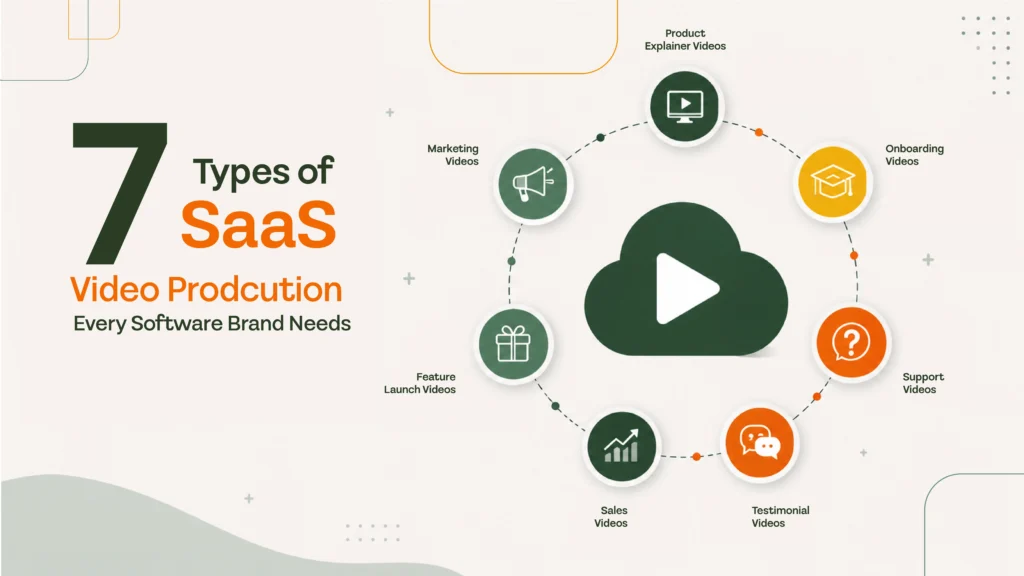
SaaS is hard to sell because the product lives behind a screen, the value shows up over time, and the buying committee needs to understand it fast. That is why SaaS video production has become one of the most effective ways to turn complex software into something buyers can see, trust, and act on. It is the mechanism that makes the product tangible, the company credible, and the decision easier.
According to Wyzowl’s State of Video Marketing, 91% of businesses now use video as a marketing tool, yet most SaaS brands still treat it as a single deliverable one explainer on the homepage, and wonder why it fails to move buyers across the rest of the funnel.
The commercial case is clear: video in a sales pitch increases the likelihood of closing a deal by 41% (Wyzowl). But that number only holds when the right type of video is used at the right stage.
A homepage explainer cannot also close an enterprise deal inside a sales deck. A product demo cannot replace the credibility that comes from a customer speaking on camera about their results. Each asset has a different audience, a different purpose, and a different structure.
This guide covers the seven types of SaaS video production that matter commercially, what distinguishes each one from the others, and which to prioritise based on where your pipeline is leaking most. See it as a reference for B2B video marketing decisions, not a general overview of what video can do.
Why Most SaaS Brands Get Video Production Wrong
The most common mistake is treating SaaS video production as a single category. A brand produces one video, places it on the homepage, and measures its success by homepage traffic alone. When it does not generate a pipeline across the full funnel, the conclusion is that video does not work for their product. The real problem is category confusion.
Each stage of the B2B buying journey requires a different type of content with a different goal, length, and tone. Gartner’s research consistently shows that B2B buyers now prefer to conduct the majority of their purchase research independently before engaging with any sales representative.
According to Gartner, 67% of B2B buyers in 2026 prefer a rep-free buying experience, meaning that for most of the journey, your video content is the sales conversation. If that content is not organised by stage and purpose, it cannot do the job.
SaaS video production is the creation of video content specifically designed to support the marketing, sales, and retention functions of a software business. Unlike consumer video marketing, SaaS video production is organized around the buyer journey; each video type serves a specific stage from awareness through to onboarding and retention.
The seven types below map directly to seven distinct commercial problems. The brands that get this right produce each type as a deliberate asset with a specific audience, a specific placement, and a specific outcome it is designed to drive.
1. Product Launch Video
The Video That Defines What Your Product Is and Why It Exists
A product launch video is a short-form flagship asset produced to announce a new SaaS product or major release. It opens with the problem the product solves, demonstrates the product in context, and ends with a clear call to action, typically a trial signup, demo request, or waitlist join.
This is not an ad. It is not a tutorial. It is the definitive visual statement of what your product is and why it exists, produced when a new product, major feature, or version goes live. It sits between a brand film and a product demo in tone: more narrative than a feature walkthrough, more specific than a brand story.
Why the First 10 Seconds Determine Everything
The opening of a product launch video carries the entire weight of whether a viewer continues watching. The instinct to lead with the product is wrong. Buyers need to recognise themselves in the problem before they care about the solution.
Salesforce’s AICRM launch video used a cinematic narrative structure, opening with the friction of disconnected data before a single product interface appeared. Monday.com’s product announcements consistently open with a question directed at a specific pain point, not with a logo or a feature name.
The production quality of the interface itself also matters more than most founders expect. Stylised UI overlays and motion graphics significantly outperform raw screen recordings in product launch videos because the interface needs to earn visual attention, not just demonstrate functionality. This is where motion graphics play a direct commercial role, not a decorative one.
Ideal length for social distribution is 60 to 120 seconds. For a product page, up to three minutes is appropriate, provided each minute is structured around a specific buyer question.
Where to Deploy a Product Launch Video
- Product pages and feature announcement pages
- Launch day distribution on LinkedIn, YouTube, and Twitter
- Press kits and media submission packages
- Investor decks and fundraising materials
When the product interface is complex, early-stage, or visually dense, animation makes a product launch video work better than live action. Eilan Digital’s animation services for SaaS brands are specifically built for this use case, where the gap between what the product looks like and what it does for the buyer needs to be closed through visual design, not raw screen capture.
2. Pre-Sales Video
The Video That Warms a Prospect Before Any Sales Call Happens
A pre-sales video is a short, targeted video asset used in outreach and sales enablement to warm a prospect before any live conversation. It introduces the product or value proposition in under two minutes, is often personalized to the recipient’s industry or role, and ends with a low-friction call to action typically a demo booking link or a reply request.
This is a distinct category from explainers and from product demos. It is deployed before the sales conversation begins, not on the public website, and it is built specifically for one-to-one or one-to-few distribution through outreach emails, LinkedIn direct messages, and ABM landing pages. The format exists because of a structural problem in B2B sales: by the time a buyer books a demo, they have already formed a strong opinion about the product. Pre-sales video reaches them earlier.
Why the Timing Matters More Than the Message
The original CEB research, later absorbed into Gartner, established that B2B buyers complete 57% of their purchase decision before speaking to a sales representative. More recent research puts that figure even higher, with Gartner’s 2024 survey of 632 B2B buyers finding that the majority prefer to avoid direct vendor contact until their shortlist is already formed. Pre-sales video is the tool that gets your product into that independent research window, rather than waiting to be evaluated alongside three other vendors in a formal demo.
A personalized pre-sales video sent to a named account in a cold outreach email consistently outperforms text-only outreach in reply rate. It does not need to be long. Under 90 seconds is the target. Under two minutes is the ceiling.
Three Pre-Sales Video Formats and When to Use Each
A talking-head video from a founder or account executive works best when the relationship and personality of the person sending it is itself a credibility signal. An animated explainer of 30 to 90 seconds is scalable and can be deployed at volume across outreach sequences. A screen-recorded personalized walkthrough built for a named account showing that product specifically applied to their stated problem requires the most effort but generates the highest response rate in enterprise sales.
Wyzowl data confirms that including video in a sales pitch increases the likelihood of closing by 41%. Pre-sales video is the earliest point in the funnel where that close-rate advantage can be activated.
Where Pre-Sales Videos Have the Highest Commercial Impact
- Cold outreach emails to target accounts
- LinkedIn direct messages to specific decision-makers
- Pre-demo landing pages for account-based marketing campaigns
- Sales follow-up after a prospect has engaged with content but not yet booked a call
3. How-To and Tutorial Videos
The Video Type That Builds Category Authority Before the Buyer Is Ready to Purchase
How-to and tutorial videos are educational SaaS video production assets designed to rank on YouTube and search engines by answering specific questions the target audience is already asking. They position the brand as a category expert before any product conversation begins.
YouTube is the world’s second largest search engine. Not producing content there is not a neutral decision: it is a missed discovery opportunity every month. Tutorial content brings in qualified audiences through organic search before they know the brand, before they are in an active buying cycle, and in many cases before they have identified their problem clearly enough to search for a solution.
Why YouTube Is the Most Underused Channel in SaaS Marketing
The Ahrefs YouTube channel is the clearest B2B SaaS proof of concept for this strategy. Ahrefs built their channel around how-to content for the SEO category tutorials on keyword research, link building, technical SEO without centering each video on the Ahrefs product. The result, as documented in their own marketing blog, is a channel that functions as a continuous lead generation engine. Thousands of customers have attributed their discovery of Ahrefs specifically to YouTube. The channel now has over 400,000 subscribers, built almost entirely through educational content.
The production cost argument is also favorable. Most of the script already exists: existing blog posts, documentation, knowledge base articles, and support FAQs are 80% of the content. The incremental production effort is the video itself. For SaaS brands already producing written content, how-to video is the highest-leverage repurposing opportunity available.
The one mistake that consistently kills watch time before the hook lands is opening a tutorial video with product promotion. The viewer came for an answer to a question. The hook must address that question first. Product context comes after the viewer’s problem has been acknowledged.
Where Tutorial Videos Generate the Most Long-Term Commercial Value
- YouTube channel as a long-term organic search asset
- Top-of-funnel brand building and discovery for audiences not yet in a buying cycle
- Knowledge base and in-product help content for existing users
- Repurposed from existing blog content at low incremental production cost
4. Case Study and Testimonial Videos
The Most Trusted Content Format in B2B Buying Decisions
Case study and testimonial videos are customer-led proof content showing real results from real users. They exist in two formats: a long-form case study of three to five minutes with structured narrative and specific data, and a short testimonial clip of 60 to 90 seconds built around one key outcome.
The structure that works for both formats is consistent: the problem the customer was facing before the product, the reason they chose this product over alternatives, the specific results achieved with numbers wherever possible, and what they would say to a peer in their industry who is considering the same decision.
Why Peer Validation on Video Outperforms Every Other Trust Signal
Written testimonials have a credibility ceiling. They can be edited, cherry-picked, or constructed. Video shows a real person, in a real environment, with real affect. The buyer watching can read the body language, hear the tone, and make their own judgment about whether what they are hearing is genuine. That is information no written case study can provide.
Industry and geography matching dramatically increases this trust effect. A mid-market SaaS buyer in the logistics sector trusts a peer from their own vertical far more than a Fortune 500 enterprise customer from a different industry, even if the enterprise outcome is objectively more impressive. When Zendesk produces customer testimonial content, the most commercially effective pieces are those where the customer role, company size, and industry match the profile of the prospect watching.
The placement with the highest conversion impact is the pricing page. This is the point in the funnel where a buyer is genuinely interested but not yet committed. The objection at this stage is almost never about price it is about risk. A testimonial video from a peer who took the same risk and describes the outcome in specific terms is the most direct response to that hesitation.
Where Case Study Videos Do the Most Work in the Sales Funnel
- Pricing pages, where purchase hesitation is highest
- Dedicated case study pages for organic search discovery
- Later-stage sales decks used by account executives
- ABM outreach targeting accounts in the same sector as the featured customer
5. Webinar Production and the Full Asset Suite
Why Webinars Are an Asset System, Not a Single Event
SaaS webinar production is the end-to-end creation of all visual and written assets required to run, promote, and monetise a webinar including the live event, all pre-event promotional materials, the presentation itself, and all post-event repurposing assets.
Most SaaS brands extract three days of value from a webinar: the promotion period, the live event, and one follow-up email. A properly structured webinar production process generates assets that work for three to six months. The recorded session on YouTube earns organic search traffic indefinitely. The highlight reel earns LinkedIn reach for weeks after the event. The sales deck version gives the sales team a credibility asset for every follow-up meeting in the following quarter.
The recorded session is not even the most valuable output. That distinction belongs to the slide deck and the post-event email series.
Every Asset a SaaS Webinar Should Generate
Before the webinar:
- Registration landing page with event details, speaker bios, and a clear value proposition for attending
- Invitation emailer and two reminder emailers (one week before, 24 hours before)
- Social banners and promotional images sized for LinkedIn, Twitter, and Instagram
- Countdown and teaser posts for organic social
During the webinar:
- Branded slide deck built to work as a live presentation and as a standalone leave-behind that can be read without context
- Branded backdrop and overlay graphics for the video feed
- Lower thirds and title cards for speaker introductions
After the webinar:
- Edited recording for YouTube and on-demand hosting on the website
- Highlight reel of two to three minutes for LinkedIn distribution in the days following the event
- Short clips of 30 to 60 seconds reformatted for YouTube Shorts and Instagram Reels
- Two versions of the follow-up emailer: one for people who registered but did not attend, one for people who attended
- Sales deck version of the presentation, reformatted for the sales team to use in follow-up meetings with prospects who attended or requested the recording
Why the Slide Deck and Post-Event Emailer Are Worth More Than the Recording
The recorded session has a natural audience ceiling: the people who were already interested enough to register. The YouTube version of the recording can grow that audience over time through organic search, but it requires that the webinar topic be built around a search-intent keyword, not just an internal editorial decision.
The post-event sales deck is the asset with the longest commercial life. Every prospect who attended the webinar, or who receives the recording link in a follow-up sequence, is now in a conversation with your sales team. The deck gives that team a structured, credible, visually consistent tool for the next stage of that conversation. Eilan Digital’s webinar asset production covers the full suite: slide design, branded overlays, post-event email templates, and highlight clip editing, because the value of the event is almost entirely in the assets built around it.
Where Webinar Assets Generate Pipeline Beyond the Live Audience
- Demand generation and top-of-funnel audience building through promoted registration
- Thought leadership content for ongoing LinkedIn distribution
- Mid-funnel nurture for prospects in extended evaluation cycles
- Enterprise sales contexts where credibility and expertise are active purchase variables
6. Promotional Videos and Shorts
The Short-Form Video Format Built for Platform-Native Distribution
Promotional videos and Shorts are platform-native short-form video assets designed for social distribution. They are built to earn organic reach and retargeting performance through brevity, authenticity, and platform-specific formatting not by repurposing longer videos into shorter cuts.
The most important word in that definition is “built.” The mistake most SaaS brands make with Shorts is treating them as a compression exercise: take the three-minute product launch video, cut it to 60 seconds, add a logo, publish. This consistently underperforms because the hook logic is completely different. The first two seconds of a Short is not the same creative problem as the first ten seconds of a demo. The format requires its own structure, its own opening, and its own internal pacing.
Why Shorts Built as Standalone Assets Outperform Repurposed Cuts
TikTok and YouTube Shorts audiences have been trained to identify and scroll past content that was not made for the format. A compressed corporate announcement reads as exactly that. The content that performs on these platforms feels immediate, direct, and human even when it is produced by a software company.
LinkedIn operates differently. Its algorithm gives video content a measurable engagement advantage over equivalent text posts on the same topic. But LinkedIn video has its own format expectations: more professional, more substantive, and more tolerant of length than Shorts or Reels. The same piece of content does not work across all three platforms. Creative digital marketing for SaaS on social requires platform-specific production decisions, not platform-agnostic repurposing.
Eilan Digital’s Shorts production for software brands is built natively for LinkedIn and YouTube Shorts as distinct assets. The hook logic, format ratio, caption timing, and closing call to action are built for the platform from the ground up.
Where Promotional Shorts Generate the Fastest Top-of-Funnel Reach
- Top-of-funnel awareness and brand visibility on LinkedIn and YouTube
- Retargeting ads for audiences who have visited the website or engaged with longer-form content
- Product feature announcements and minor release updates
- Event promotion and behind-the-scenes content from team moments or conference appearances
7. Onboarding and Training Videos
The Video Type That Reduces Churn Before It Starts
Onboarding and training videos are post-sale SaaS video production assets that guide new users through product setup and feature adoption. They reduce time to value, decrease support ticket volume, and directly improve retention by ensuring users experience the product’s core value as quickly as possible.
Most SaaS brands invest the majority of their video budget in acquisition and almost nothing in onboarding. This is commercially backwards. According to Wyzowl, 62% of marketers report that video content reduced support queries. Churn in SaaS products typically begins in the first two weeks, when users fail to reach an activation moment the point at which the product’s core value becomes personally evident. Onboarding video is the most direct tool for closing that gap.
Why Most SaaS Brands Invest in Acquisition and Lose Customers at Onboarding
The economics of churn are not subtle. Acquiring a new customer costs five to seven times more than retaining an existing one. If a user churns at day 14 because they could not figure out how to configure a core feature, the acquisition cost of that customer was entirely wasted. Onboarding video addresses this at the point of highest risk.
The format has evolved beyond linear tutorial recordings. Conversational branching video tools such as Tolstoy and VideoAsk allow SaaS brands to deploy personalised onboarding journeys embedded directly in the product. Each user sees only the path relevant to their role or use case. A marketing manager onboarding into a project management tool gets different guidance than an engineering team lead — and the video responds to their path through the product rather than presenting a generic sequence.
Beyond churn reduction, onboarding video improves feature adoption (users discover capabilities they would otherwise miss), reduces inbound support volume (fewer tickets for questions the video already answers), and enables customer success teams to scale (a well-structured video library replaces repetitive one-to-one calls for common setup questions).
Where Onboarding Videos Have the Highest Retention Impact
- In-app onboarding flows triggered by specific user actions or setup milestones
- Knowledge base and self-serve help documentation
- Customer success team enablement, replacing high-volume repetitive calls
- Support ticket deflection for common setup and configuration questions
Which Type of SaaS Video Production Should You Start With
The most common mistake is attempting to produce all seven types simultaneously. Production capacity is not unlimited, and trying to build everything at once typically means nothing is built well. The correct starting point is diagnostic: identify the most expensive current problem in your pipeline and match it to the video type designed to address that problem.
If your biggest problem is
Start with this type
Buyers do not understand what the product does
Product launch video
Low organic discovery and brand awareness
How-to and tutorial videos
Buyers stall at the decision or pricing stage
Case study and testimonial videos
Events are not generating pipeline beyond the event week
Full webinar asset suite
Low brand visibility on LinkedIn and social
Promotional Shorts
Users churn within the first 30 days
Onboarding and training videos
Common SaaS Video Production Mistakes to Avoid
One video, one purpose myth. Expecting a single explainer to handle awareness, consideration, and decision simultaneously. These are three different audiences in three different states of mind. The same video cannot speak to all three effectively.
Feature-led demos. Showing every feature rather than two or three specific scenarios that directly address buyer pain points. Buyers do not buy features. They buy outcomes. A demo that walks through the feature list is a demo built for the product team, not the buyer.
Shorts as repurposed cuts. Cutting down a three-minute demo into 60 seconds and expecting it to perform on Shorts. The hook logic and format are structurally different. A Short built from scratch for the platform will consistently outperform a compressed version of a longer asset.
Webinar as a one-day asset. Running a webinar without planning the full pre and post asset suite. The live session is roughly 10% of the commercial value. The other 90% comes from the assets generated around it: the registration campaign, the branded deck, the edited recording, the highlight reel, the Shorts clips, the follow-up email series, and the sales deck version.
Skipping onboarding video. Treating video as a purely pre-sale investment while ignoring the retention impact of post-sale content. Churn is a revenue problem. Onboarding video is a revenue tool, not a support tool.
Unsourced statistics in scripts. Using unverified numbers in product videos and case studies damages credibility with technical buyers who check the figures. Every statistic in a script should be attributable to a named source.
What All Effective SaaS Video Production Has in Common
Clarity of purpose. Every video knows exactly who it is for, what stage of the journey that person is at, and what specific action it is designed to drive. Vague video is expensive to produce and produces no pipeline.
Scenario-driven, not feature-driven. The viewer needs to see themselves solving a problem, not a demonstration of product capability. Context and outcome come first. The feature is the mechanism, not the message.
Quality matched to credibility. The production quality must match the trust the video is designed to convey. A hand-recorded testimonial from a real customer in their real office can outperform a polished corporate film when authenticity is the primary trust signal. A product launch video for an enterprise sale requires a different standard.
Platform-native format. The same content requires different packaging for each distribution channel. Length, aspect ratio, hook logic, caption style, and tone all change by platform. Distribution is not an afterthought: it is part of the production decision.
How Eilan Digital Supports SaaS Video Production
For SaaS brands that need to move beyond screen recordings into something that does commercial work, the production challenge is usually one of three things: making a complex interface look visually compelling, turning a single event or campaign into a multi-format asset suite, or building short-form content that is genuinely native to the platform rather than a cut-down version of something else.
Eilan Digital’s animation services cover the production of motion graphics and animated explainers for product launch videos where raw UI screenshots are not enough. For product demos that need 3D UI overlays and animated interface sequences, the same capability applies. For webinar asset production, the full suite slides, banners, emailers, lower thirds, and highlight clip editing is produced as a coordinated package rather than disconnected deliverables. For promotional Shorts, production is built natively for LinkedIn and YouTube Shorts as standalone assets, not repurposed cuts.
The visual production services page covers the broader scope of what this involves for SaaS brands at different stages of building out their video infrastructure.
Conclusion
SaaS video production is not one video. It is a coordinated system of distinct asset types, each doing a specific job at a specific stage of the buyer and customer journey. The product launch video earns attention at announcement. The pre-sales video converts interest into meetings. Tutorial content earns organic discovery over months and years. Case study videos close the hesitation at the decision stage. Webinars generate pipeline through thought leadership and are then repurposed into months of content. Shorts earn platform-native reach. Onboarding video protects the revenue already won.
The brands winning in SaaS in 2026 are treating video as infrastructure, not a campaign. Each asset type feeds the next. Tutorial content builds the audience that attends the webinar. The webinar generates the credibility that makes the case study more convincing. The case study closes the deal that the pre-sales video opened. Together, they create a compounding marketing advantage that is difficult for competitors to replicate quickly, because it is built through consistent production over time, not a single launch.
The first step is identifying which type your current pipeline is missing most. Start there, measure the commercial impact, and expand from that foundation.
Planning your first SaaS video or building out a full video marketing programme? Eilan Digital produces animation, motion graphics, webinar asset suites, and promotional Shorts for software brands that need video to do commercial work, not just look good.
FAQs
Previous
Let’s talk about what
you’re building.
Whether you’re refining a brand, preparing a market launch,
or bringing clarity to a complex product, we help translate
intent into structured, effective execution.