
What Good Corporate Website Development Looks Like in 2026
If you have a business that you are running for a long time, there is a possibility your clients or consumers will try to find you online. The best way to reach them is a good functional website that increases your visibility online, making your business reach to more people.
Good corporate website development in 2026 means a site that passes Core Web Vitals without exception, is built mobile-first rather than adapted for mobile, and guides visitors through clear conversion pathways instead of leaving them to figure it out.
It means the site is built around actual business goals, not just brand aesthetics, and has SEO architecture built into the foundation, not bolted on after launch. That is the baseline. Everything below that is a website that exists, not one that performs.
Our team at Eilan Digital has spent years building corporate websites for manufacturing, industrial, and B2B brands, the kind of companies where a website has to perform well and explain technical products clearly, build trust with buyers who research for months before ever making contact, and hold up under scrutiny from procurement teams and engineers alike. That experience shapes everything in this article.
This article breaks down the 2026 benchmarks across performance, UX, SEO, and architecture, what corporate website development actually costs, a self-assessment checklist to see where a current site stands, how to think through the platform decision, and what to look for when evaluating a development partner.
What Corporate Website Development Actually Means
Corporate website development is the strategic, technical, and visual process of designing and building a website that represents a company’s credibility, communicates its value to multiple stakeholders, and is engineered to generate qualified leads and support business objectives.
In 2026, it must also account for AI search discoverability, WCAG 2.2 accessibility compliance, India’s DPDP Act 2023, and performance-first architecture.
A corporate website carries a different job than these other formats. A portfolio site exists to showcase creative work. An e-commerce site exists to process transactions. A campaign microsite exists to support a single time-bound push. A basic builder-tool website exists mainly to have a web presence at all.
A corporate website exists to do all of the following at once: build credibility with buyers, investors, and partners, explain what the company actually does, and convert research into contact.
In 2026, that job comes with new requirements that didn’t exist a few years ago. AI search discoverability now matters as much as traditional search rankings since a growing share of buyers first encounter a company through an AI-generated answer rather than a search results page.
Corporate Website vs. Basic Website
A basic website and a corporate website solve different problems, and the gap between them shows up across every layer of the build.
| Dimension | Basic Website | Corporate Website (2026 Standard) |
|---|---|---|
| Strategic Intent | Establish a web presence | Support lead generation, credibility, and business objectives |
| Tech Architecture | Template based, minimal customisation | Custom architecture matched to team and scale needs |
| SEO Depth | Basic meta tags | Structured data, topical authority, AI search readiness |
| Content Structure | Generic pages by department | Pages structured around the buyer's research journey |
| Performance Standards | No defined benchmark | Core Web Vitals compliance as a hard requirement |
| Security | SSL only | HSTS, HTTP/3, DPDP Act 2023 compliance, bot protection |
| Integrations | None or basic contact form | CRM, marketing automation, analytics, ERP, where relevant |
| Scalability | Rebuilt as the business grows | Built to expand across regions, languages, and product lines |
The 2026 Performance Benchmarks Your Website Must Meet
Core Web Vitals: The Non-Negotiable Floor
Google measures three things when it decides whether a page delivers a good experience. These numbers are not optional targets. They are the floor.
- LCP (Largest Contentful Paint): under 2.5 seconds. This measures how fast the main content of a page loads. Large, uncompressed images are the most common cause of failure here.
- INP (Interaction to Next Paint): under 200 milliseconds Google officially replaced First Input Delay with INP as a Core Web Vital on March 12, 2024, and it now measures responsiveness across an entire visit rather than just the first click. Excessive JavaScript is the usual culprit when a site fails this metric.
- CLS (Cumulative Layout Shift): under 0.1. This measures visual stability, whether elements jump around as a page loads. Dynamic content loading without reserved space is the typical cause of failure.
Google Search Central is the authoritative source for all three thresholds, and Search Console reports on them directly against a live site.
Mobile-First Is Architecture, Not Just Responsive CSS
Over 60% of B2B research happens on mobile, even in industrial and manufacturing sectors where the final purchase decision is anything but casual.
There is a real distinction worth understanding here. Responsive design adjusts a layout to fit different screen sizes. Mobile-first means the site is architected and load-optimised for mobile as the primary environment from the start, not as an afterthought.
The common failure looks like this: a site designed for desktop first, technically responsive, that still takes 7 to 9 seconds to load on a 4G connection. In urban India, where 4G penetration is near universal, that load time is not a technical footnote. It is a direct lead quality variable.
Page Speed as a Business Metric
This section is worth putting directly into a leadership pitch deck. Every 1 second delay in load time reduces conversions by roughly 7%, according to research from Akamai. Pages that load within 2 seconds see bounce rates around 9%. Pages that take 5 seconds see bounce rates jump to 38%.
The practical benchmark to aim for is under 3 seconds on mobile, on a mid-range 4G connection. The most common speed killers on Indian corporate sites are uncompressed hero images, unused plugin scripts, and the absence of a CDN (Content Delivery Network).
What Good UX Looks Like on a Corporate Website in 2026
Navigation That Mirrors How B2B Buyers Actually Research
B2B buyers typically visit 3 to 5 pages before making contact. Navigation should reflect that research journey, not the company’s internal org chart.
The most visited pages on B2B corporate sites, in order, are: Homepage, Services or Products, About Us, Case Studies, and Contact. Navigation should be structured around that path, not around internal departments or service categories that only make sense to people inside the company.
Visual Hierarchy and Content Prioritisation
Eyes move across a screen in predictable patterns, commonly described as F-pattern and Z-pattern reading behavior, and good design accounts for this rather than fighting it.
The above-the-fold rule for 2026 is simple: the primary value proposition must be visible without scrolling, on any device. Body text should run at a minimum of 16px, with contrast ratios meeting WCAG 2.2 AA standards of at least 4.5:1 for normal text.
White space also functions as a trust signal. A cluttered corporate website reads as lower credibility to a B2B buyer, whether that judgment is conscious or not.
Trust Signals That Convert Visitors Into Inquiries
Client logos, case studies, and certifications belong above the fold on key landing pages, not buried three scrolls down.
The About Us page is typically the second most visited page on a B2B website, which means it needs to do real work on credibility, not just list a mission statement. Security badges, SSL indicators, and a visible privacy policy all signal data safety to enterprise procurement teams doing their own due diligence.
Technical Architecture That Actually Scales
CMS Selection: Match the Platform to the Team, Not the Trend
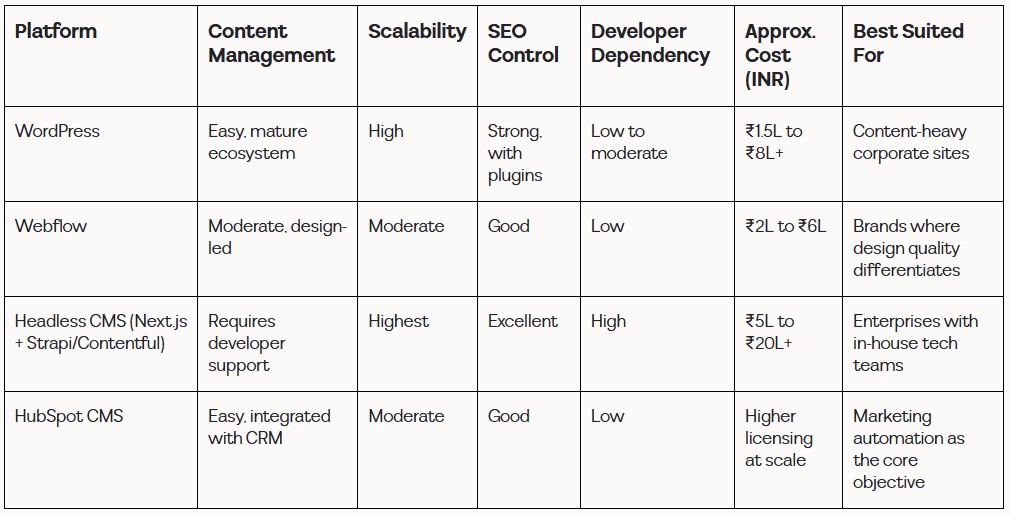
| Platform | Content Management | Scalability | SEO Control | Developer Dependency | Approx. Cost (INR) | Best Suited For |
|---|---|---|---|---|---|---|
| WordPress | Easy, mature ecosystem | High | Strong, with plugins | Low to moderate | ₹1.5L to ₹8L+ | Content-heavy corporate sites |
| Webflow | Moderate, design-led | Moderate | Good | Low | ₹2L to ₹6L | Brands where design quality differentiates |
| Headless CMS (Next.js + Strapi/Contentful) | Requires developer support | Highest | Excellent | High | ₹5L to ₹20L+ | Enterprises with in-house tech teams |
| HubSpot CMS | Easy, integrated with CRM | Moderate | Good | Low | Higher licensing at scale | Marketing automation as the core objective |
WordPress powers roughly 43% of all websites, and its large Indian developer pool keeps costs manageable compared to more specialised platforms. Webflow offers strong Core Web Vitals performance out of the box and suits brands where design is a genuine differentiator. Headless setups using React or Next.js offer the highest performance ceiling but come with the highest developer dependency, and suit enterprises running multi-region deployments. HubSpot CMS makes sense specifically when marketing automation and CRM are the primary objective, though licensing costs rise with scale.
Integration Architecture: What "Connected" Really Means
A corporate website needs to talk to the rest of the business, not other businesses. Connected to the businesses means integrated in the workflow.
CRM integration, through HubSpot, Salesforce, or Zoho, should mean every form submission flows directly into a sales pipeline, not into a spreadsheet someone checks once a week.
Marketing automation should have email triggers, lead scoring, and behavior tracking connected from day one. Manufacturing and industrial sites need ERP integration for product catalogs, dealer locators, and spec sheet downloads. The analytics baseline should include GA4, Google Search Console, and either Microsoft Clarity or Hot jar at minimum.
Security and Legal Compliance in 2026
SSL is table stakes at this point. The real 2026 focus is on HTTPS Strict Transport Security and HTTP/3 support.
India’s Digital Personal Data Protection Act 2023 has made cookie consent management and data storage policy real development requirements, not legal afterthoughts to bolt on before launch.
Bot protection and DDoS resilience matter for any site expecting traffic from paid campaigns. A security audit should be treated as a defined deliverable, so it is worth asking any vendor directly whether it is included in the scope or billed separately.
SEO Architecture Built Into the Foundation, Not Bolted On After
Why Most Corporate Websites Are Built SEO-Blind
SEO usually gets added after launch, as a plugin or an afterthought, which is exactly backwards.
Retroactive SEO fixes cost far more than building for search from the discovery phase. Decisions made during the build, URL structure, heading hierarchy, canonical tags, crawl budget management, image alt text conventions, and schema markup, cannot be fully retrofitted later without significant rework.
Structured Data and AI Search Readiness in 2026
The schema types most relevant to a corporate website are Organization, BreadcrumbList, FAQPage, Service, and LocalBusiness.
In 2026, structured data directly influences what Google AI Overviews pull, what Perplexity cites, and how ChatGPT references a brand when someone asks about vendors in a category. E-E-A-T signals matter too: dedicated author pages, credential citations on team profiles, and internal linking between blog content and service pages all reinforce that a site is a credible source, not just a page that exists.
Site Architecture and Internal Linking for Topical Authority
Pillar pages and cluster pages let each service and industry page rank independently rather than competing with each other. Internal link equity should flow from the homepage through service pages to case studies to blog content.
A useful rule: no important page should sit more than 3 clicks from the homepage. Many Indian corporate sites carry deep, nested URL structures left over from legacy WordPress installs, and this remains one of the most common technical SEO blockers we see in audits.
Industry-Specific Requirements: One Standard Does Not Fit All
Manufacturing and Industrial Companies
These sites need a product catalog with advanced filtering, downloadable technical spec sheets, and compliance documents. A dealer and distributor locator with geographic filtering matters for reach. Multi-language support serves international procurement teams and export-oriented businesses, and CAD file download portals with certificate verification pages support serious technical buyers. Embedding 3D product visualization and rendering directly into product pages is one of the more effective additions here.
SaaS and Technology Companies
The pricing page alone is close to a standalone discipline: feature comparison tables, FAQ blocks, and a monthly or annual toggle are all tested, and deliberate elements.
An integrations page showcasing ecosystem compatibility is a primary trust signal for SaaS buyers. Documentation and developer resource portals should be linked directly from the main navigation.
CTA hierarchy matters too, a primary CTA above the fold, a secondary one after social proof, and an exit-intent CTA on scroll or exit.
Healthcare and Professional Services
MCI compliance in India makes consent forms and patient data handling disclaimers development requirements, not legal add-ons. Doctor and specialist profile pages need to be built for E-E-A-T, with credentials, publications, hospital affiliations, and photos. Appointment booking should connect directly to calendar systems. WCAG 2.2 AA accessibility compliance is both a legal expectation and a genuine trust signal in this sector.
Real Estate Developers
Project listing pages need filtering by location, property type, configuration, and stage of construction. RERA-compliant data display, registration numbers, carpet area, and completion timelines, is non-negotiable. 3D architectural walkthroughs and virtual site tours embedded directly into project pages help buyers evaluate a property that may not exist yet. A prominent WhatsApp and call CTA matters here too, since high-intent real estate buyers want immediate human contact, not a form to fill out and wait.
What to Look For in a Corporate Website Development Partner
The Evaluation Criteria That Actually Matter
| Evaluation Factor | What to Look For |
|---|---|
| Portfolio relevance | Have they built for your industry or a comparable one in the last two years? |
| Technical capability | Can they produce Lighthouse scores, CWV data, or performance audit reports from past projects? |
| SEO competence | Do they discuss site architecture and structured data, or only page design and CMS? |
| Process transparency | Do they provide a phase-based project plan with defined deliverables and approval gates? |
| Post-launch support | Is maintenance, performance monitoring, and content update support included or billed separately? |
| Integration experience | CRM, analytics, marketing automation: have they built these connections before? |
| Communication model | A single point of contact through the project, or hand-offs between teams that lose context? |
| India market knowledge | Do they understand Indian B2B buyer behavior, regional compliance, and INR cost structures? |
Five Questions to Ask Before Signing Anything
- Who owns the source code and CMS credentials at project completion?
- How is scope creep defined, documented, and priced in the contract?
- Will the handover include documentation, training, and a post-launch support window?
- Can they share 3 live websites built in the last 18 months, along with Search Console and Lighthouse performance data?
- What does the process look like from the client’s side, how many review rounds, how long for revisions, and who is the day-to-day contact?
The 2026 Corporate Website Self-Assessment Checklist
Performance
- Does the site load in under 3 seconds on a mid-range Android device on 4G?
- Does it pass all three Core Web Vitals in Google Search Console?
- Does it score 80 or above on Lighthouse Performance?
UX and Design
- Is the primary value proposition visible above the fold on mobile without scrolling?
- Does the navigation reflect the buyer’s research journey rather than the company’s internal structure?
- Is there a clear, prominent CTA on every key page?
SEO Architecture
- Does every page have a unique H1 tag?
- Is structured data implemented for Organization and FAQPage at minimum?
- Are there any broken internal links or redirect chains?
- Is an XML sitemap submitted to Google Search Console?
Content Quality
- Does each service page answer what it is, who it is for, why it matters, and what to do next?
- Are case studies or client references visible without deep navigation?
Trust Signals
- Is SSL active and the site served over HTTPS?
- Is a cookie consent management solution in place, as required under India’s DPDP Act 2023?
- Is there a team or leadership page with real names, photos, and credentials?
Technical
- Can the marketing team update content without raising a development ticket?
- Is CRM or lead management integration live and verified?
- Is analytics tracking confirmed as active in GA4?
Accessibility
- Does the site meet WCAG 2.2 AA colour contrast ratios?
- Do all images have descriptive alt text?
- Is the site navigable by keyboard alone?
A corporate website built to 2026 standards is a business infrastructure decision. This checklist shows what good looks like. If the current site fails more than three categories, the conversation with leadership is not about whether to rebuild; it is about when.
This article walked through seven areas that matter: definition and distinction, performance benchmarks, UX standards, technical architecture, SEO foundation, industry-specific requirements, and partner evaluation.
The next step is to complete the checklist above and know exactly which gaps need solving before writing a single brief. Then hire an agency to give you the best solution for your website.
Eilan Digital is happy to review a completed checklist and share direct feedback, or to walk through examples of what this standard looks like in practice. If you are looking for a website audit or revamp, schedule a call now.
FAQs
Previous
Let’s talk about what
you’re building.
Whether you’re refining a brand, preparing a market launch,
or bringing clarity to a complex product, we help translate
intent into structured, effective execution.