
What Industries and Products Can Benefit From 3D Product Modeling?
Every product photoshoot a brand does today produces an asset with a shelf life. Change the color, add a variant, update a feature, and the images become obsolete along with the studio time, samples, and budget.
This is the quiet cost that most marketing teams simply spend, however photographs are useful but come with limitations.
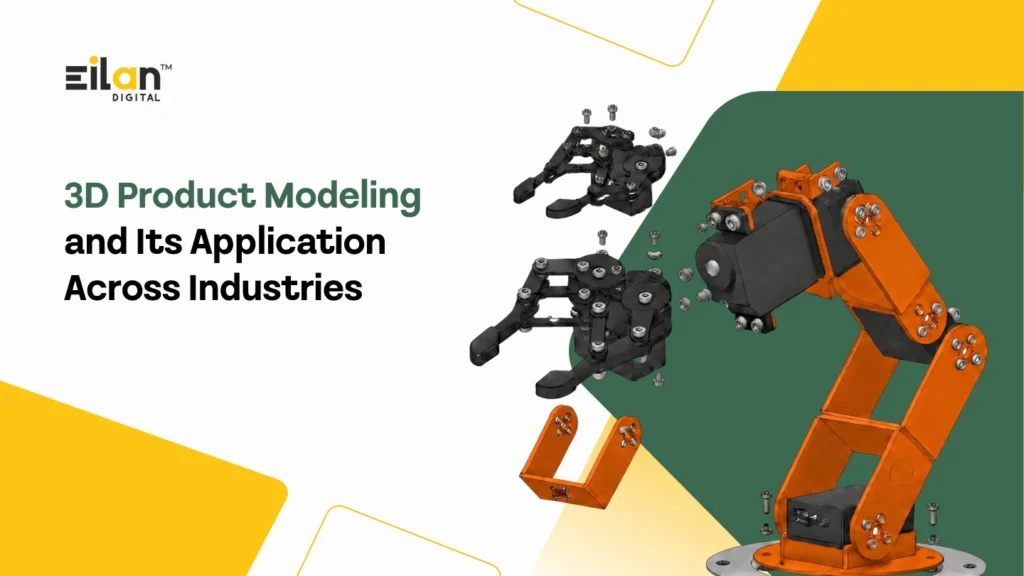
3D product modeling is the practice of building a digital three-dimensional representation of a physical product in specialized software, then using that single file to generate photorealistic images, animations, and interactive experiences without studio, samples, and often no finished product required.
IKEA has been proving the economics of this for two decades as far back as 2014, IKEA’s IT manager Martin Enthed confirmed in an interview with the Computer Graphics Society that roughly 75% of the product images in IKEA’s catalog were fully computer-generated, not photographed at all a shift the company made purely to cut cost and improve consistency at scale.
That’s the headline case, but it’s far from the only one. The real question worth asking isn’t whether 3D modeling “applies” to a given industry; it’s which specific production problem it solves. Some industries are held back by variant volume, huge products, or by mechanisms no camera can see inside.
Below is a working breakdown of where 3D modeling earns its budget, where photography still wins, and how to tell which camp your product falls into.
1. Automotive and EV Brands
Car and motorcycle brands sell the same vehicle in a dozen trims, a dozen colors, and increasingly a dozen powertrain options. Photographing every combination is a logistics exercise most marketing budgets can’t absorb and pre-launch vehicles can’t be photographed at all, since they don’t physically exist yet in showroom-ready form.
3D modeling collapses that problem into a single asset. Once a vehicle is modeled, every trim and colorway becomes a render, not a reshoot. The same base model also powers an online configurator, letting buyers spec out a vehicle before a single unit reaches a dealership, and it opens the door to cutaway animations of motors, battery packs, and safety systems that a camera physically cannot capture.
This is exactly the brief Eilan Digital worked on with electric two-wheeler brand YoBykes, building out full-lineup 3D visualization to support a pan-India dealership expansion, and with Piaggio, producing renders and animation across its APE commercial vehicle range. In both cases, the 3D asset did double duty supporting both showroom marketing and dealer-facing sales material from a single production effort.
2. Consumer Electronics
In electronics, the visual is the pitch. Buyers judge build quality, material finish, and design intent almost entirely through imagery and product cycles; they now move faster than a studio can realistically keep pace with new models, and new models often need marketing assets before manufacturing has finished tooling.
3D modeling lets that marketing work happen in parallel with production instead of after it. It also renders detail that’s genuinely hard to shoot consistently, such as port placement, speaker mesh, bezel lines, brushed-metal versus matte-plastic finishes across a whole product range, under identical lighting every time.
The highest-value applications tend to be exploded-view animations for technical or instructional content, finish and colorway variants without building physical samples of each, and 360-degree spins for e-commerce listings, which, as covered below, measurably change how confidently people buy.
3. E-Commerce and Consumer Goods
For any brand with a large catalog, photography cost scales in a straight line, one shoot per product, per variant, per angle. 3D modeling breaks that line.
IKEA’s 75% figure is the standard reference point here, but the more useful takeaway is why the company made the switch? Not for a novelty effect, but because rendering a sofa in forty colorways costs a fraction of photographing forty physical samples.
The commercial impact of adding 3D and AR to product pages is now measurable. According to Shopify, merchants that add 3D content to their product pages see an average 94% increase in conversions compared with standard product listings.
Beyond conversion gains, AR also helps shoppers make more informed purchase decisions by allowing them to visualize products in their own environment, which many retailers report can reduce returns by improving buyer confidence and setting more accurate expectations before purchase.
Within e-commerce, the categories that benefit most are the ones with the highest variant counts like furniture and home goods, packaged goods with multiple label or size SKUs, and accessories like eyewear.
At Eilan Digital, our work with eyewear retailer Framesbuy is a direct example, where 3D visualization replaced physical sample photography across frame styles and colorways.
4. Industrial and Manufacturing Equipment
A compressor, a heat exchanger, or an industrial valve can’t move to a photo studio, and even if it could, a photograph still couldn’t show what buyers actually need to see.
Mechanisms such as how fluid moves through it, how components interact, and how it integrates into an existing line.
This is where 3D modeling becomes closer to a sales tool. A well-built model can effectively substitute for an early-stage factory visit; a prospective buyer can be walked through how equipment operates before a site visit is ever scheduled.
Cross-section and exploded-view animations show tolerances and internal mechanisms that no photography workflow can touch.
In our collaboration with Kirloskar Brother Lted (Pump manufacturing), Hawle Valve (valve mechanism visualization), and ET TMT (steel products) all sit squarely in this category of technical, mechanism-first visual assets built for buyers who need to understand function.
5. Healthcare and Medical Devices
Medical devices come with two constraints; they’re often small and visually similar to competitors, and clinical imagery is frequently restricted by regulatory guidelines. 3D modeling gives device marketers a compliant way to illustrate application and mechanism without depending on live clinical photography.
A single device, a surgical instrument, an implant, a diagnostic tool needs to speak differently to a surgeon, a hospital procurement team, and a patient. One 3D model can generate assets tailored to each audience, mechanism-focused renders for clinicians, application context for patient education, and clean product shots for procurement decks, all without separate physical setups for each audience.
6. Furniture and Home Furnishings
Furniture brands were among the earliest adopters of 3D modelling at scale, largely because a single sofa design offered in dozens of fabric and colour options would otherwise require extensive physical photography. IKEA remains one of the best-known examples of this shift.
In 2014, Martin Enthed, IT Manager at IKEA Communications, revealed that 75% of IKEA’s product images and 35% of its room scenes were computer-generated, while maintaining photorealistic quality and reducing production complexity.
Furniture is also where 3D modeling connects most directly to AR. A model built for a static catalog render can be repurposed, largely as-is, for a “view in your room” AR experience, and that repurposing is where the Shopify conversion data above becomes especially relevant since furniture is one of the categories where buyers most want to de-risk a purchase before it arrives.
7. Footwear and Apparel Accessories
A single sneaker silhouette released in twenty colorways means twenty physical samples, each with its own production, shipping, and photography cost attached before a single unit is ready for sale.
Seasonal timelines make this worse as brands often need finished marketing imagery before physical samples exist at all.
CGI product rendering in footwear is now well past the experimental stage. Adidas’s internal CG production team has publicly documented its Sneaker Rendering Pipeline (SRP), an automated content pipeline built on Unreal Engine 5 that renders footwear into contextual, sport and lifestyle scenes at production scale built specifically because, as the team described it, the goal was rendered content that could hold up next to real photography rather than look like an obvious digital stand-in. That’s a useful data point on where the category’s technical bar now sits.
The single biggest quality differentiator in footwear rendering is material accuracy, leather grain, mesh breathability, rubber texture, and how each behaves under different lighting. That level of realism depends on material libraries built from physical reference samples, which is the production investment that separates a convincing render from one that reads as obviously synthetic.
8. Packaging and FMCG
FMCG brands routinely launch multiple SKUs, size variants, and region-specific label versions of the same product simultaneously. Photographing a gift set means physically assembling, styling, and shooting every combination by hand; a 3D-modeled gift set can be reconfigured digitally in a fraction of the time.
The same logic applies to regional label variants; one base 3D model with swapped label art covers every market a brand ships to, without a separate shoot for each.
The highest-value moment for this is pre-production, when packaging design is still being finalized but marketing assets are already due; a 3D model lets creative and manufacturing move in parallel instead of one waiting on the other.
3D Product Modeling vs. Photography: A Straight Comparison
| Factor | 3D Product Modeling | Photography |
|---|---|---|
| Cost per variant | Low, rendered from one base model | High, each variant needs its own shoot |
| Works before the product exists | Yes | No, as it requires a physical unit |
| Internal mechanisms | Fully visible via cutaway / exploded views | Not possible without a destructive process |
| Large or immovable products | No logistical limit | Requires studio or on-site setup |
| Scale and proportion accuracy | Mathematically precise | Dependent on the photographer and setup |
| Revision cost | Low, model updated digitally | High, often requires a reshoot |
| Speed at scale (many variants) | Faster | Slower |
| Speed for a single simple product | Slower, to brief and build | Faster |
| Material authenticity | Depends on model/texture quality | Naturally accurate |
Photography remains useful when:
- Authentic, organic texture is the product’s selling point (handmade goods, artisan food, natural materials with irregularity CGI struggles to replicate)
- The brief calls for lifestyle photography where human presence and environmental authenticity are the point
- There’s a single product with no variants, and a shoot is genuinely cheaper than a model build
- Turnaround is tight enough that a same-week studio shoot beats a modeling brief-to-delivery cycle
A Quick Decision Framework
| If your situation is... | The likely answer is... |
|---|---|
| Multiple color, size, or material variants | Strong case for 3D render every variant from one model |
| Product is large, heavy, or immovable | 3D modeling is often the only practical option |
| Buyers need to understand internal mechanisms | 3D modeling is the only way to show this clearly |
| Marketing assets are needed before the product exists | 3D modeling is the only option |
| Sold across regions with different label variants | Model the base product once, swap labels per market |
| Single product, no variants, simple form | Traditional photography may be faster and cheaper |
| Product relies on organic texture as its selling point | Traditional photography still does this better |
| Planning AR or an interactive configurator | 3D modeling is a prerequisite, the same model powers both |
Three Myths Worth Busting
It's only for big-budget brands.
3D renders still look obviously digital.
3D modeling replaces creative strategy.
Where This Is Headed
Two shifts are worth watching. First, AI-assisted texturing, lighting, and rendering is compressing production timelines without a corresponding drop in output quality; repetitive setup work that used to take days is increasingly automated, which lowers cost and shortens brief-to-delivery windows.
Second, and more structurally important: a 3D model is not a single-use asset. The same file that generates a static product render can be repurposed into an AR experience, an interactive web configurator, or a product animation, and platforms are actively building for this. Shopify’s own product data, cited above, already shows the commercial upside of AR-enabled listings; the brands positioned to capture that upside are the ones that already have a 3D asset ready to deploy, rather than starting from zero.
How Eilan Digital Approaches This Across Industries
Across the sectors above, the through-line in Eilan Digital’s work is the same, build the asset once, and let it generate more than one commercial output. In automotive and EV, that’s meant full lineup and color-variant libraries for YoBykes
In industrial and manufacturing, it’s meant mechanism-level visualization and cross-section renders for Kirloskar Brother and Hawle Valve. In consumer products, it’s meant material- and colorway-accurate rendering for eyewear brand Framesbuy. The brief changes by industry, but the underlying production logic remains the same.
You can see more of this work on our 3D Product Visualization page and in the 3D section of the portfolio.
If you’re weighing 3D product modeling for an upcoming launch or catalog refresh, Eilan Digital offers a 1:1 consultation to map out where a 3D asset would replace the most expensive part of your current production process, which you can book right away.
FAQs
Previous
Let’s talk about what
you’re building.
Whether you’re refining a brand, preparing a market launch,
or bringing clarity to a complex product, we help translate
intent into structured, effective execution.