
Animated Explainer Videos for B2B Products With a Long Sales Cycle
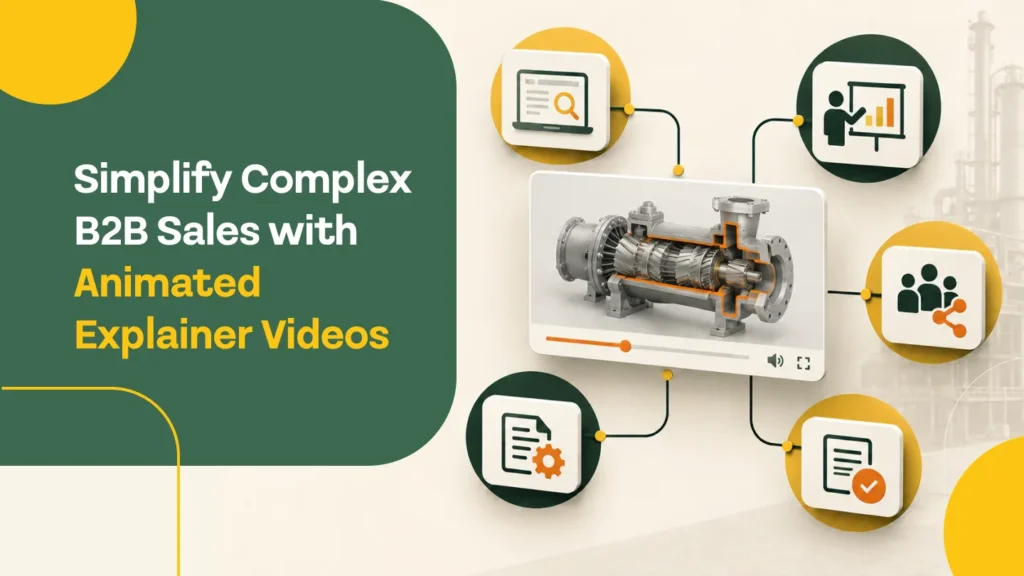
Selling a B2B product can take weeks or months. The buyer may need to understand how the product works, where it fits into an existing system, what problem it solves, how it compares with alternatives, and whether it meets technical requirements.
The challenge in selling becomes harder when several people are involved in the decision. A product manager may want to understand its features. An engineer may want to examine how it works. Procurement may want commercial clarity. A business head may care about the operational outcome.
Animated Explainer Videos can give all of these stakeholders a consistent way to understand the product.
That does not mean animation replaces a sales team, technical documentation, or product demonstrations. Its value is different. It gives the product a visual explanation that buyers can revisit, share internally, and use at different points in the evaluation process.
Here’s why B2B enterprises should care about the animation explainer video and how agencies like Eilan Digital can help B2B marketing teams take their message to next level.
Why B2B Products Take Longer to Sell
A long B2B sales cycle is rarely caused by one issue. The product may be expensive, technically complex, or tied to an important operational decision. Buyers may also need approval from several departments before a purchase can move forward.
The process can involve:
- Technical evaluation
- Product comparisons
- Procurement reviews
- Demonstrations
- Internal discussions
- Budget approval
- Compliance or quality checks
- Management approval
Research from Gartner describes B2B buying as a series of recurring tasks such as problem identification, solution exploration, requirements building, supplier selection, validation, and consensus creation. Buyers may move back and forth between these tasks rather than follow a straight path.
That has an important implication for product communication.
The person who first discovers your product may not be the person who approves it. They may need to explain it to someone else later. That second person may have completely different questions.
A product catalogue can provide specifications. A website can provide detailed information. A sales presentation can provide context. Technical documents can support validation.
But the product may still need to be explained again.
An animated explainer can give the sales and marketing teams one clear visual reference that stays useful throughout that process.
Where Animated Explainer Videos Fit Into a Long B2B Sales Cycle
1. First Product Introduction
At the beginning, buyers need a basic understanding of what the product does and why it exists.
A technical product can be difficult to communicate in a few sentences, especially when its value depends on how several components work together.
An explainer can establish the basic picture quickly:
The problem → the product → how it works → where it is used → what it delivers
This gives the buyer enough context to decide whether the product deserves a deeper evaluation.
The video does not need to cover every specification at this stage. Its job is to make the product understandable enough for the next conversation.
2. Website Research
A product page filled with specifications may answer detailed questions, but it can be difficult for someone encountering the product for the first time.
Placing a product explainer video on the relevant page gives visitors another way to understand the offering.
This is particularly useful when the product involves a process, internal mechanism, or technical application that is difficult to communicate through photographs.
The buyer can watch the explanation, read the specifications, and decide what information they need next.
3. Sales Presentations
Sales teams often explain the same product repeatedly.
That repetition is not necessarily a problem. In fact, it is often necessary. The problem is inconsistency.
Different salespeople may describe the same mechanism differently. A technical feature may be explained in more detail during one meeting than another.
A central video gives the team a controlled explanation of the product. Salespeople can then spend more of the meeting discussing the buyer’s specific requirements instead of rebuilding the product story from scratch.
4. Internal Sharing
This is one of the most useful applications for a long sales cycle.
Suppose an operations manager attends a sales meeting, but the final decision also involves the engineering head and procurement team. The original presentation cannot always be recreated for everyone.
A short product video can be shared internally.
The new stakeholder can see how the product works, understand the basic application, and enter the next conversation with some context already established.
For B2B products, this matters because buying decisions are usually made by groups rather than a single person. Gartner’s research also points to the role of shared information in helping buying groups reach consensus.
5. Technical Evaluation
This is where animation can offer something conventional filming often cannot.
A machine may have components hidden inside its housing. A filtration system may involve a process that cannot be seen. A pharmaceutical product may require an explanation of a biological or chemical mechanism. An industrial coating may need to be shown at a microscopic or material level.
Animation can expose these processes visually.
A 3D model can be cut open. Components can be separated. Fluid movement can be illustrated. A sequence can show what happens before, during and after operation.
Instead of asking the viewer to imagine the mechanism from a technical description, the video can show it.
6. Follow-Up After a Sales Meeting
A quotation or presentation may not be enough to keep the product fresh in the buyer’s mind.
An explainer can become part of the follow-up material.
The sales team can send the same video discussed during the meeting, along with the relevant documentation or proposal. The buyer can revisit the explanation later or forward it to another stakeholder.
This gives the sales conversation a useful visual reference between meetings.
7. Final Evaluation and Approval
The video does not close the deal on its own.
By this stage, the buyer may already be comparing suppliers, reviewing technical details and discussing commercials. But a familiar explanation can still help stakeholders revisit how the product works and why it fits the requirement.
For a long sales cycle, that continuity matters.
The product may be introduced in one month and evaluated several months later. A reusable video helps maintain the same core explanation throughout that period.
Why Animated Explainer Videos Work for Complex B2B Products
They Can Show What a Camera Cannot
Traditional product filming is excellent when the physical product itself is the story.
But some products are difficult to film meaningfully.
Consider a large industrial machine. A camera can show its exterior, but that does not necessarily explain what happens inside.
Animation can move through the machine, isolate individual components, and show the relationship between them.
The same principle applies to microscopic processes, internal workflows, chemical reactions, software-driven systems, and technical applications.
They Turn Technical Information Into a Sequence
Technical information is often presented as separate facts.
A product has a certain component. It operates at a certain capacity. It uses a particular process. It is designed for a specific application.
An effective explainer connects those facts.
Instead of presenting features independently, it can show how one part leads to another and how the complete system works.
That distinction is useful for complex products because buyers are often trying to understand relationships, not simply collect specifications.
They Show How the Product Works
A photograph shows what a product looks like.
An animated video can show what it does.
That is particularly useful for machinery, engineering systems, filtration equipment, automation solutions, and other industrial products where operation is central to the buying decision.
They Give the Brand Control Over the Explanation
With animation, the brand controls the sequence.
You decide which component appears first, what is highlighted, what terminology is used, and how the product’s application is explained.
That control is useful when the product requires a specific technical narrative.
They Create a Reusable Sales Asset
One well-produced video can serve several functions.
It can appear on a website, run during a sales presentation, support an email follow-up, play at an exhibition, or be shared by a distributor.
That makes the video part of the broader sales and marketing system rather than a one-time campaign asset.
Animated Explainer Videos vs Traditional Product Videos
The two formats serve different communication needs.
| Requirement | Animated Explainer Video | Traditional Product Video |
|---|---|---|
| Showing the real product | Possible through 2D or 3D representation | Strong |
| Internal mechanisms | Strong | Often difficult |
| Invisible processes | Strong | Limited |
| Manufacturing process | Strong | Strong when filmable |
| Technical storytelling | Strong | Depends on production |
| Product demonstration | Strong | Strong |
| Showing a real facility | Limited unless combined with live footage | Strong |
| Explaining complex workflows | Strong | Depends on filming approach |
This does not mean a B2B company has to choose one format.
A strong product communication strategy may combine live-action footage, 3D animation, motion graphics, and technical illustrations.
For example, a manufacturing video could open with real footage of the facility, move into a 3D animation of the product’s internal mechanism, and return to live footage showing the finished application.
The format should follow the communication problem.
How Different B2B Industries Can Use Animated Explainers
Manufacturing
Manufacturing companies can use animation to explain machinery operation, engineering components, assembly processes, and internal mechanisms.
Consider an industrial equipment manufacturer selling a machine with several moving components. Filming the machine running may show the result, but it may not explain the interaction between those components.
A 3D animation can isolate each part and show its role in the complete operation.
Manufacturing explainer videos are also useful for products that are too large, expensive, or difficult to transport for repeated demonstrations.
Pharmaceutical and Healthcare
Pharmaceutical and healthcare products often involve processes that cannot be captured through conventional product footage.
Animation can illustrate mechanisms of action, manufacturing processes, delivery systems, medical technologies and product applications.
The level of technical detail should depend on the intended audience. A video for a technical audience can go deeper than one designed for a broader business audience.
Industrial Products
Industrial product videos can explain equipment, filtration systems, automation, energy systems, and engineering applications.
For example, an animation for an industrial filtration product could show the movement of material through the system, identify filtration stages, and explain where the product fits into a larger process.
The buyer sees the role of the product rather than only its physical appearance.
Botanical and Horticulture Products
Animation can also help businesses with technical plant and horticulture portfolios.
A company working with specialised plant varieties could use animation to explain propagation, cultivation systems, product characteristics, or differences between varieties.
This can be useful when the product portfolio is broad and customers need a simple way to understand how different offerings fit their requirements.
What Should a B2B Product Explainer Video Include?
A good product explainer does not try to turn every technical document into a five-minute video.
A useful structure is:
- The buyer’s problem: What needs to be solved?
- The product: What is being offered?
- How it works: What happens when the product is used?
- Key features: Which features matter to the application?
- Practical use: Where and how is it applied?
- Benefits: What does the buyer gain?
- Supporting proof: What information can build confidence?
- Next step: What should the viewer do after watching?
The order can change depending on the product.
The important point is to build the story around buyer understanding rather than around a list of company features.
A technically accurate video can still fail if the viewer cannot understand why each detail matters.
Where to Use Animated Explainer Videos in B2B Marketing
A B2B video should not live only on YouTube.
Depending on the product and sales process, it can support:
- Product and service pages
- Homepage content
- Sales presentations
- Email follow-ups
- LinkedIn campaigns
- Paid digital campaigns
- Dealer and distributor presentations
- Trade shows
- Exhibitions
- Internal sales training
- Customer onboarding
This is where B2B video marketing becomes more useful than treating video as a standalone advertising format.
The same core video can support several conversations, provided it has been planned for those uses from the start.
Shorter versions can be created for social platforms. Specific sections can be adapted for sales presentations. Product animations can also be reused in future marketing material.
When Should a B2B Company Invest in an Animated Explainer Video?
An animated explainer is worth considering when:
- The product takes more than a few sentences to explain.
- Different stakeholders repeatedly ask the same questions.
- The product has technical complexity.
- Important components or processes are hidden.
- Sales teams rely heavily on presentations.
- Buyers need repeated explanations before making a decision.
- The company sells across different locations or markets.
- A physical demonstration is difficult, expensive, or impractical.
- The product needs to be understood before a live demonstration can be useful.
It may not be necessary when the product is self-explanatory, a simple image communicates the value clearly, or a live demonstration already provides everything the buyer needs.
The goal is not to add animation to every B2B marketing plan.
The goal is to use it where visual explanation solves a real communication problem.
How to Make an Animated Explainer Effective for B2B Buyers
Start With the Buyer's Questions
A product video should answer the questions the buyer is likely to have.
What does it do? How does it work? Where is it used? Why does this particular mechanism matter? What makes it suitable for the application?
Starting with these questions produces a more useful video than simply listing product features.
Simplify Without Losing Technical Accuracy
Simplification does not mean removing important information.
It means presenting technical information in a way that can be followed.
The script, visuals, and terminology should be reviewed by people who understand the product. A visually attractive video is of little value if it introduces technical inaccuracies.
Show the Mechanism
Use 3D models, cutaways, diagrams, process animation, and motion graphics when they improve understanding.
Do not animate something simply because it looks interesting.
Every visual should have a communication purpose.
Keep Product Information Consistent
Product names, specifications, terminology, visual details, and claims need to remain accurate.
This becomes particularly important when the same video is used by marketing, sales, distributors, and product teams.
Plan for Multiple Uses
Think about the video’s complete life before production begins.
Will it sit on a product page? Will a salesperson use it in a meeting? Will a distributor present it to customers? Will sections be used at an exhibition?
Planning these requirements early can influence the script, aspect ratios, voiceover, animation style, and final edits.
The Role of Animation in a Long B2B Buying Process
For a complex B2B product, the communication challenge does not end when the first presentation is over.
The buyer may return to the website. Another stakeholder may enter the discussion. The technical team may ask for clarification. Procurement may compare alternatives. Management may need a simpler explanation.
The product keeps moving through the organisation, and its explanation needs to move with it.
That is the real advantage of an animated explainer video.
It gives the company a consistent visual explanation that can be used across different points in the buying process. It supports the sales conversation without pretending to replace it.
For complex products, the strongest role of animation is simple: it helps the product stay understandable while the buyer takes the time needed to make a decision.
For brands in manufacturing, pharma, engineering, industrial products, and other technical categories, that requires more than animation skills. It requires understanding the product, the buyer, and the sales process behind it. That is where Eilan Digital’s work across animation, 3D product visualisation, product videos and motion graphics can support technical B2B communication.
FAQs
An animated explainer video is a short video that explains a product, service, process, or concept using scripted narration and visual techniques such as 2D animation, 3D animation, motion graphics, and technical illustration.
They make technically complex products easier to understand and give multiple stakeholders a consistent explanation that can be reused across websites, sales meetings, presentations, and follow-ups.
It gives buyers a visual reference they can revisit and share during research, technical evaluation, internal discussions, and follow-up conversations. It supports the sales process rather than replacing it.
A product explainer video focuses on helping an audience understand what a product does, how it works, and where it can be used. It is different from a broader corporate video, which may focus more on the company, its people, facilities, or brand story.
Yes. They can explain machinery, internal mechanisms, manufacturing processes, engineering components, assembly systems, and applications that may be difficult to communicate through conventional filming.
Previous
Let’s talk about what
you’re building.
Whether you’re refining a brand, preparing a market launch,
or bringing clarity to a complex product, we help translate
intent into structured, effective execution.