
The Real Benefits of 3D Animation in Manufacturing Explained
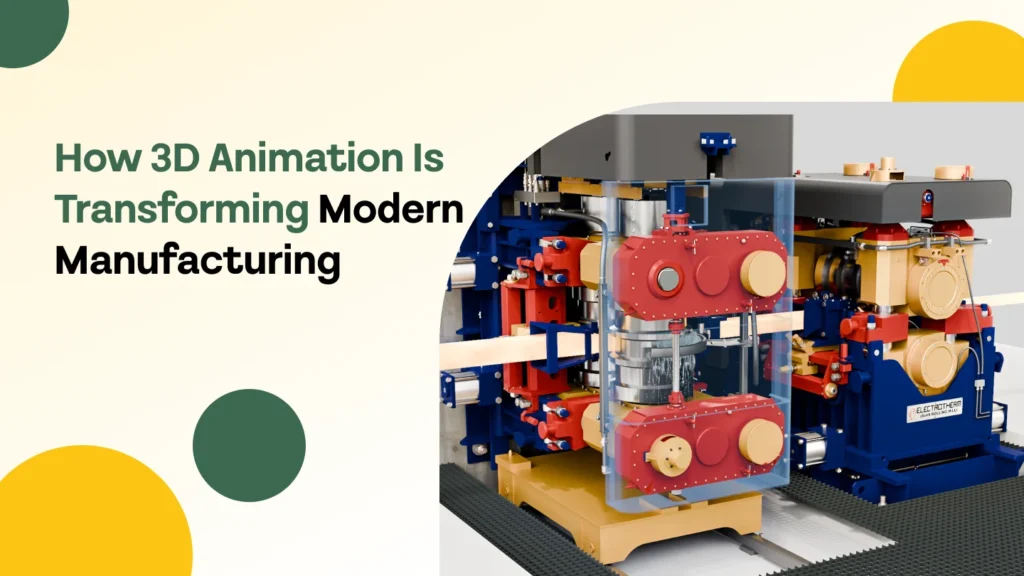
Manufacturing products are often difficult to show, not just difficult to explain.
A photograph can show what a machine looks like. It cannot always show what happens inside it. A factory video can capture a production line, but it may not clearly explain the movement of material through a system. A newly designed product may need to be presented to customers before a physical prototype is ready.
This is where 3D animation in manufacturing becomes useful.
The real value of 3D animation is not that it makes an industrial product look impressive. Its value is that it gives manufacturers control over what the audience sees. Internal components, operating mechanisms, assembly sequences, product concepts and manufacturing processes can all be presented in a way that would be difficult, concepts, or impossible to capture with a camera.
For companies selling complex B2B products, that distinction matters. When a product takes technical knowledge to understand, the right visual can make the explanation much clearer.
Why Manufacturing Products Are Difficult to Explain Visually
Industrial products rarely have a simple story.
A machine may contain dozens of components working together. A component may perform a function that is invisible from the outside. An engineering system may depend on a sequence of processes that cannot be understood from a single image.
There are other practical problems too.
Large machinery may be difficult to transport for a product shoot. Certain manufacturing processes may be hazardous or inaccessible to film. Products under development may not physically exist yet. And the same product may need to be explained to engineers, procurement teams, distributors, sales teams and business decision-makers, each with a different level of technical knowledge.
A manufacturing product can be difficult to explain visually because important functions may happen inside the product, involve multiple components or require technical context that a static photograph cannot provide.
That is the communication barrier 3D animation can address.
What Is 3D Animation in Manufacturing?
3D animation in manufacturing uses digitally created three-dimensional models, environments and motion to explain products, machines, components, processes and applications.
The process usually brings together several elements:
3D modelling → Texturing → Lighting → Animation → Rendering
For a manufacturer, these are not simply production steps. Together, they create a controlled visual representation of how a product looks, works or fits into a larger process.
The starting point may be CAD data, engineering drawings, product references or other technical information. The 3D model can then be developed into a visual asset that shows the parts and functions relevant to the audience.
This is why 3D manufacturing animation is different from simply creating a digital version of a product. The purpose is communication. The model needs to support a story about the product, its mechanism, its application or its manufacturing process.
The Real Benefits of 3D Animation in Manufacturing
The strongest case for 3D animation for manufacturing comes from situations where conventional visual content has a limitation.
Here are the practical benefits manufacturers should consider.
1. Show How a Product Works
A product demonstration does not have to stop at showing the outside of a machine.
With 3D animation, components can be shown moving, interacting and performing their intended functions. A pump, filtration system, industrial machine or engineered component can be presented through a step-by-step sequence.
The viewer can see:
- What happens first
- Which components move
- How different parts interact
- What happens during operation
- How the system reaches its intended outcome
This is particularly useful when the product’s value depends on its mechanism rather than its appearance.
A machine that looks relatively simple from the outside may have a complicated operating principle. Animation gives the manufacturer a way to explain that principle visually.
2. Show What a Camera Cannot Capture
This is one of the clearest reasons to use industrial 3D animation.
A camera has physical limitations. It cannot simply see through a machine, remove a component without changing the product, or show an internal process at any scale the viewer needs.
3D animation can do all these things. It can be used for:
- Internal components
- Cutaway views
- Cross-sections
- Exploded views
- Hidden mechanisms
- Component interactions
- Internal movement
Consider an industrial machine with a motor, shaft, bearings and other internal components. A conventional product video can show the finished machine operating. A 3D product animation can separate those components visually and show how they work together.
That changes the role of the visual. The product is no longer simply being displayed. It is being explained.
3. Explain Complex Products More Clearly
Technical information is not necessarily difficult because the product is poorly designed. It can be difficult because the information is spread across drawings, specifications, manuals and verbal explanations.
Animation can bring several parts of that explanation into one visual sequence.
For an engineer, it can clarify component interaction.
For a procurement team, it can explain how a system functions.
For a distributor, it can provide a straightforward product demonstration.
For a non-technical decision-maker, it can establish the basic relationship between the product, its function and its application.
The aim is not to remove technical information. It is to arrange that information so the viewer can understand and follow it.
A useful structure for many industrial products is:
What it is → How it works → Where it is used → Why it matters
That is often easier to absorb than a page of technical specifications presented without visual context.
4. Visualize Products Before Physical Production
Manufacturers do not always have the luxury of waiting for the finished product before beginning communication.
A new machine may still be under development. A product redesign may exist only as CAD files. A company may want to present a future product at a trade show before manufacturing is complete.
This is an area where 3D animation offers something conventional product photography cannot.
A digitally created product can be presented before a physical unit is available.
That can support:
- New product concepts
- Products under development
- Product variants
- Future machinery
- Product redesigns
- Pre-launch communication
It also gives product and marketing teams a visual asset earlier in the product development cycle.
The animation does not need to wait for the factory floor.
5. Demonstrate Manufacturing Processes
Some manufacturing processes are difficult to communicate through conventional video because the full process is too long, too large, too fast, too slow or too complicated to capture in one sequence.
Manufacturing process animation can simplify the process without losing the stages that matter.
It can show:
- Production sequences
- Assembly
- Material movement
- Process flow
- Machine interaction
- Quality or testing stages
The advantage is control.
A real production environment contains background activity, people, equipment and movement that may distract from the process being explained. A 3D animation can isolate the relevant stages and present them in the order the audience needs to understand them.
This is useful for marketing, product communication and training, particularly when the real process is difficult to film.
6. Create Better Product Demonstrations
There is a difference between showing a product and demonstrating it.
A product shoot is usually constrained by the physical object, location, lighting and camera position. Animation provides much greater control over the presentation.
The manufacturer can decide:
- Which camera angle the viewer sees
- How quickly a mechanism moves
- Which sequence comes first
- Which component remains visible
- When a product should be cut open
- When components should separate
- Where attention should go
An exploded view, for example, can show how multiple components fit together without requiring the physical product to be dismantled.
This makes 3D product visualization particularly useful for engineering products where structure and function are closely connected.
7. Give Sales Teams a Reusable Technical Asset
A good manufacturing animation does not have to live on the website and nowhere else.
The same asset can become part of the sales process.
A sales team can use it during a customer meeting. A distributor can use it in a product presentation. A business development team can include it in a follow-up email. The same animation can run at an exhibition or trade show.
This matters because B2B sales teams often explain the same technical concepts repeatedly.
Instead of relying entirely on a salesperson to explain how a machine works, the animation can establish the visual explanation first. The salesperson can then focus the conversation on the customer’s application, requirements and commercial questions.
In that sense, manufacturing animation can become a sales enablement asset rather than simply a marketing video.
8. Communicate the Same Product Consistently
Manufacturers operating across regions often have several people explaining the same product.
Sales teams may describe it one way. Dealers may demonstrate another aspect. Marketing may focus on different features.
A single approved 3D animation provides a common visual reference.
It can support:
- Sales
- Marketing
- Dealers
- Distributors
- Exhibitions
- Product pages
- Digital campaigns
This does not eliminate the need for localized communication. It gives different teams a consistent representation of the product itself.
For companies selling technically complex products across several markets, that consistency can make product communication easier to manage.
9. Make Industrial Products Easier to Understand for Non-Technical Buyers
Not every person involved in a B2B purchase needs to understand every engineering detail.
A procurement head may need to understand the system’s purpose and operation. A business owner may want to know where the product fits into the larger process. A distributor may need to explain the product to customers who have limited technical knowledge.
A well-planned animation can establish the basic logic of a product before the viewer gets into detailed specifications.
What is it?
How does it work?
Where is it used?
Why does that matter to the buyer?
That does not replace engineering documentation. It gives the viewer a visual starting point.
10. Build Content That Can Be Reused Across Channels
A 3D animation does not have to be treated as one finished video.
A master animation can often be planned so that different sections or scenes can be reused in different formats.
For example, one product animation may produce:
- A full product video
- Short social media clips
- A product-page video
- An exhibition loop
- A sales presentation visual
- Process-specific snippets
- Feature animations
This changes how manufacturers can think about the investment.
The question is not simply, “How much does one animation cost?”
A better question is, “How many useful product communication assets can be built from the same 3D work?”
That is a more practical way to evaluate 3D animation services.
Where Is 3D Animation Used in Manufacturing?
| Application | What 3D Animation Shows |
|---|---|
| Product visualization | Product structure and appearance |
| Machine demonstration | Operation and movement |
| Internal mechanism | Hidden components and functions |
| Manufacturing process | Process flow and stages |
| Product assembly | Component-by-component assembly |
| New product launch | Products before physical production |
| Sales presentation | Product benefits and working |
| Exhibition | Continuous product demonstration |
| Training | Processes and operating sequences |
| Product marketing | Features, applications and use cases |
The right application depends on what the manufacturer needs the audience to understand.
There is little value in animating a product simply because 3D is available. The visual should solve a communication problem.
3D Animation vs Live-Action Product Video for Manufacturing
| Requirement | 3D Animation | Live-Action Video |
|---|---|---|
| Show finished product | Strong | Strong |
| Show internal mechanism | Strong | Difficult |
| Show invisible processes | Strong | Limited |
| Show a future product | Strong | Not possible before production |
| Show real factory environment | Limited | Strong |
| Show actual operators | Limited | Strong |
| Demonstrate technical mechanism | Strong | Depends on product |
| Control every visual element | Strong | Limited |
| Show hazardous or inaccessible processes | Strong | Difficult |
Neither format is automatically better.
Live-action is valuable when the factory, operators, machinery and real-world environment are part of the story. 3D animation becomes more useful when the product’s internal structure, mechanism or process needs to be controlled and visualized.
For many manufacturers, the strongest approach is to use both.
A factory film can establish the reality of the manufacturing operation. A 3D sequence can then explain what the camera cannot show.
Which Manufacturing Products Benefit Most From 3D Animation?
Machinery and Equipment
Industrial machinery can be shown through assembly sequences, operating cycles and internal component movement.
Automotive and Auto Components
3D animation can explain parts, mechanisms, assembly and how a component functions within a larger vehicle system.
Industrial Components
Bearings, pumps, valves, filtration systems, electrical components and other engineered products can benefit when their structure or operation needs explanation.
Engineering Systems
Pharmaceutical Manufacturing
Electrical and Industrial Technology
What Makes a Good 3D Manufacturing Animation?
Technical accuracy should come before visual spectacle.
A manufacturer is using the animation to communicate something about a real product. If the product representation is inaccurate, attractive visuals do not solve the problem.
Accurate Product Representation
Clear Technical Storytelling
The viewer should understand what is happening and why it matters.
The animation needs a logical sequence, not simply a collection of impressive camera movements.
The Right Level of Detail
More detail does not automatically make an animation more useful.
If a bearing, fastener or internal component does not contribute to the explanation, showing it in extreme detail may distract from the point.
The level of detail should match the audience and purpose.
Strong Visual Hierarchy
The component or process that matters should be easy to identify.
If everything is moving, glowing or being highlighted at once, nothing gets the viewer’s full attention.
Business-Relevant Messaging
Technical specifications have a place. But the animation should connect product features to actual applications and buyer needs.
A manufacturer does not need to animate every line from its product brochure.
It needs to show the parts of the product that help the audience understand its function and application.
When Should a Manufacturing Company Consider 3D Animation?
3D animation is particularly useful when:
- The product is difficult to understand from photographs
- Internal mechanisms need explanation
- The product is still under development
- A physical product demonstration is difficult
- The manufacturing process needs explanation
- A sales team repeatedly explains the same technical concept
- The company needs content for multiple markets
- One product visual needs to work across sales and marketing
- The product contains functions that cannot be shown from the outside
- A process is hazardous, inaccessible or impractical to film
The decision should start with the communication problem.
If a conventional photograph or video already explains the product clearly, 3D may add little. If the important part of the product cannot be seen, that is when 3D starts making a stronger case.
The Role of 3D Animation in Manufacturing
3D animation earns its place when a manufacturing product needs to be understood, not simply seen.
It can show what is inside a machine, how components interact, how a process works and what a product will look like before it is physically available.
That makes it useful well beyond conventional advertising. A single animation can support product marketing, sales presentations, exhibitions, product launches, dealer communication and technical explanation.
For manufacturers with complex B2B products, the starting point should therefore not be the question, “Can we make this look good in 3D?”
The better question is:
What does our audience need to see that a photograph or live-action video cannot easily show?
That answer will tell you whether 3D is the right medium.
At Eilan Digital, we create 3D product visualization and animation for complex B2B and industrial products, translating engineering information into visual content that sales, marketing and business teams can actually use.
FAQs
The main benefits are clearer product visualization, easier explanation of complex mechanisms, the ability to show internal or invisible processes, product visualization before physical production, and reusable content for sales, marketing and technical communication.
Manufacturers use 3D animation for product demonstrations, internal mechanism visualization, manufacturing process animation, product launches, assembly explanations, sales presentations, exhibitions, training and product marketing.
3D manufacturing animation is the use of digitally created three-dimensional models, environments and motion to explain manufactured products, machinery, components, systems and manufacturing processes.
It turns technical information into a visual sequence. Instead of relying only on photographs, drawings or verbal explanations, viewers can see how components move, interact and perform their functions.
Yes. 3D animation can show internal components, cross-sections, cutaways, exploded views and hidden mechanisms without physically dismantling the machine.
Previous
Let’s talk about what
you’re building.
Whether you’re refining a brand, preparing a market launch,
or bringing clarity to a complex product, we help translate
intent into structured, effective execution.