
Industrial Branding Services for B2B Firms Without In-house Marketing Team
An engineering company can spend years perfecting a product. A manufacturer may have decades of experience behind its processes. A pharmaceutical or biopharma company may work with products and systems that take years of technical knowledge to develop.
But when a potential buyer visits the website, receives a product brochure, or meets the company at an exhibition, they do have only a few minutes to understand all of that expertise.
That creates a particular challenge for industrial B2B companies. The business may know its products inside out, but communicating that knowledge clearly requires more than a logo, a website, and occasional social media posts.
The problem becomes harder when there is no dedicated marketing team. The founder approves messaging, the sales team creates presentations, the product team supplies technical information, a designer handles brochures, and an external vendor manages the website. Each person may do their part well, but nobody necessarily owns the complete brand story.
This is where Industrial Branding Services can make a practical difference.
The first job is not designing the brand. It is understanding the business well enough to communicate it properly.
Why Industrial B2B Companies Struggle With Marketing Without a Dedicated Team
Industrial companies are rarely simple businesses to market. The marketing challenge is usually a combination of complexity, limited internal bandwidth, and fragmented execution.
The business is complex
A typical industrial company may need to communicate:
- Multiple product categories
- Technical specifications
- Different applications
- Different buyer groups
- Multiple industries served
- Long evaluation and sales cycles
A buyer may also not be the only person involved in the decision. A product can be evaluated by an engineer, specified by another stakeholder, approved by management, and purchased by a procurement team.
The brand has to make sense to all of them.
Marketing gets divided between other teams
When there is no marketing function, existing teams naturally take on parts of the job.
Sales handles customer communication. Founders approve positioning. Product teams explain technical details. Designers create individual assets. External vendors work on specific projects.
What is often missing is someone connecting these activities.
What Industrial Branding Actually Means for a B2B Company
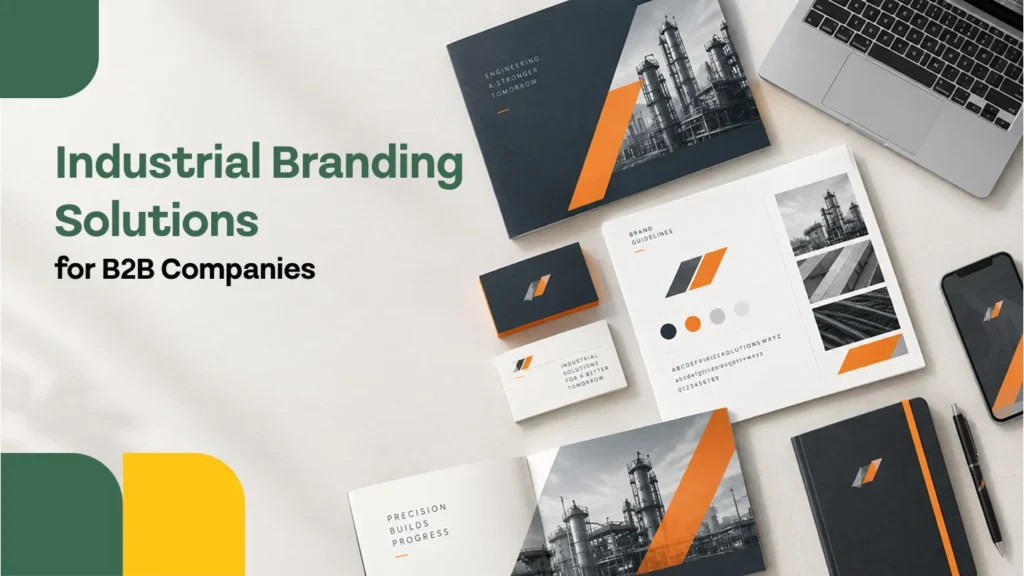
Industrial branding is often reduced to visual identity. Logo, colours, fonts, business cards and a brand guideline document.
Those things matter, but they are only part of the job.
Industrial branding is the process of defining, designing, and consistently communicating an industrial company’s identity, products, expertise, and value to its B2B audience across sales, digital, and physical touchpoints and customer base.
For an industrial business, branding should help answer basic questions clearly:
- What does the company do?
- Who does it serve?
- What does it manufacture or provide?
- Where are its products used?
- What problems do those products solve?
- How do they work?
- What makes the company different?
- Why should a buyer trust its claims?
A buyer may encounter the company through a simple search on Google, then move to a product page, LinkedIn, a sales presentation, a product video, and eventually an exhibition or sales meeting.
These are different touchpoints, but they should not feel like different companies.
That is one of the central jobs of an industrial brand.
Why Business Understanding Is Essential to Industrial Branding Strategy
Understand the Product
Understand the Buyer
Understand the Sales Process
Understand the Competition
What alternatives does the buyer consider? What genuinely sets the company apart?
Without this understanding, even good design can miss the point. Industrial brand strategy should give every piece of communication a clear direction.
What Should Industrial Branding Services Include?
There is no single package that every industrial company needs. The right mix depends on the company’s stage, products, audience, and sales process.
For a technical B2B company, however, several areas tend to work together.
Brand Strategy and Positioning
Before creating visual assets, the brand needs clarity around:
- Who is the company is
- What it wants to be known for
- Who it serves
- Where it competes
- What it offers
- What makes it different
- How it should communicate that difference
This gives the sales, website, and marketing teams a common message to work with.
Brand Identity and Guidelines
A manufacturing brand needs a visual system that works beyond the corporate logo.
This can include:
- Visual identity
- Brand guidelines
- Typography
- Colour system
- Graphic language
- Presentation templates
- Marketing templates
The purpose of an industrial brand identity is not simply to make the company look consistent. It should make consistency easier for the people using the brand.
Sales teams should not have to redesign every presentation. Marketing teams should not have to decide the visual treatment for every new campaign.
Product Communication
Industrial products often need more explanation than a standard marketing image can provide.
Product communication can include:
- Product brochures
- Product pages
- Technical graphics
- Product presentations
- Product videos
- Explainer content
- 3D visualisation
The objective is to translate technical information into something a buyer can understand and use.
Animation and 3D Product Visualisation
Some industrial products cannot be explained properly through photography alone.
A machine’s internal mechanism may not be visible.
A component may sit inside a larger assembly.
A technical process may be difficult to film.
A new product may not yet exist physically.
This is where 3D product visualization and technical animation can help.
For example, a 3D visual can show:
- Internal machinery
- Product cross-sections
- Moving components
- Product mechanisms
- Industrial workflows
- Technical applications
- Assembly processes
Animation can explain how something works instead of asking the buyer to interpret a static technical drawing.
Visual Production
There are situations where real footage is the better choice.
Factories, machinery, production processes, employees, facilities, and product applications can provide evidence that generated or illustrative visuals cannot.
Industrial visual production can cover:
- Factory photography
- Machinery photography
- Product photography
- Corporate films
- Product videos
- Aerial production
- Process films
- Application videos
For a manufacturing company, showing the actual facility and people behind the product can also add context to the company’s capabilities.
Website and Digital Presence
A manufacturing website should do more than display company information.
It should help a potential buyer understand the business and find the information they need.
That means thinking carefully about:
- Website structure
- Product pages
- Technical information
- User experience
- Applications
- Industries served
- Lead-generation points
- SEO foundations
This is where manufacturing website design needs to account for the buying process.
A product page should not simply list specifications. It should help the reader understand what the product is, where it is used, what it does, and what they should do next.
Digital Marketing
Branding does not stop when the website goes live.
Industrial companies may need ongoing support across:
- SEO
- Paid media
- Social media
- Content marketing
- Email marketing
- Analytics
The purpose is to keep the brand active and make its expertise easier to find.
For companies targeting specific industries or technical product categories, B2B marketing for manufacturing companies also needs a different approach from consumer marketing. The content needs to account for technical searches, longer consideration periods, and multiple stakeholders.
Exhibition Communication
For many industrial businesses, exhibitions remain important points of contact with prospective buyers.
But an exhibition presence is more than building a stall.
The brand may need:
- Exhibition concepts
- Stall design
- Product visuals
- Product videos
- Brand Communication
- Product communication
- Supporting sales material
The exhibition should feel like a physical extension of the brand the buyer has already encountered online.
Why Your Sales Team Should Be Able to Use the Brand
An industrial brand becomes more useful when the sales team can work with it.
Salespeople should be able to answer basic questions quickly:
- Who are we?
- What exactly do we make?
- Which industries do we serve?
- Where are our products used?
- Why should a buyer consider us?
- What makes our product different?
- How can we explain the product quickly?
This leads to a useful way of looking at branding:
Branding as a Sales System
Not a sales platform. A collection of communication assets that make selling easier.
These can include:
- Sales presentations
- Product brochures
- Product videos
- Technical illustrations
- Case studies
- Product pages
- Company profiles
- Visual explainers
If a salesperson has to create a new presentation every time a prospect asks for information, the brand system is not doing enough work.
The brand should give the sales team material that is accurate, current and easy to adapt.
A brand is more useful when the people selling the product can actually use it.
From One-Off Deliverables to One Connected Brand
Consider an industrial machinery company.
Its website explains a machine one way.
The brochure uses a different product image.
The sales presentation contains an outdated brand Guideline.
The exhibition stall follows another visual style.
The product video was produced by a different vendor and uses different terminology.
None of these assets has to be poor on its own.
Together, they can make the company feel less organised than it actually is.
A better approach is:
One product story → one visual language → multiple formats.
The same product understanding can inform the:
- Brand Story
- Website
- Product brochure
- 3D visual
- Explainer video
- Sales deck
- Exhibition graphics
- Social content
This is one reason a broader industrial branding agency can be useful. Strategy, design, visualisation, video, web development and digital marketing do not have to operate as separate projects.
They can work from the same understanding of the business.
How an External Marketing Partner Can Work With an Industrial Company
Working with an external team does not have to mean handing over marketing to an agency and walking away.
For a company without an internal marketing team, it can mean adding a specialised team around the existing business.
Stage 1: Understand
Stage 2: Define
Stage 3: Build
Stage 4: Explain
Stage 5: Deploy
Stage 6: Maintain
Keep the system current with ongoing content, digital marketing, new product assets and updates.
This approach can give an industrial company access to different specialist capabilities without having to build every function internally.
When Should an Industrial Company Consider External Industrial Branding Services?
External support can make sense when:
- You have strong products but struggle to explain them clearly.
- Your company has grown but the brand has not kept pace.
- Marketing is being handled informally across sales and management.
- Different vendors are creating disconnected assets.
- Your website does not explain your products well.
- Sales teams repeatedly create their own presentations.
- Your product requires technical visualisation.
- You are preparing for a new product launch.
- You attend industry exhibitions regularly.
- You need consistent communication across digital and physical touchpoints.
- You need ongoing marketing support but do not want to build a full internal team.
There are also situations where a large branding engagement may not be necessary.
If your positioning is already clear, your identity is consistent, your website communicates your products well and your sales assets are current, the requirement may simply be ongoing marketing or a specific project.
A good industrial marketing agency should be able to tell you that too.
How to Choose an Industrial Branding Agency
The right agency for an industrial company is not necessarily the agency with the most polished consumer-brand portfolio.
Look for evidence that the team can understand technical businesses and communicate them clearly.
1. Can they understand technical products?
Ask how they approach product discovery.
Do they speak to product teams? Do they study technical documentation? Do they ask about applications and use cases?
2. Do they understand B2B buying?
An industrial purchase can involve several stakeholders.
The agency should understand that the person consuming the content may not be the final decision-maker.
3. Can they explain, not just decorate?
Look at their work and ask whether it makes a complex product easier to understand.
Good industrial branding should improve comprehension, not only appearance.
4. Can they work across formats?
An industrial company may need a website, product video, 3D visual, presentation, exhibition presence and digital content.
The agency should be able to connect those formats.
5. Can sales actually use what they create?
Ask to see practical sales assets.
A brand that works only in a brand presentation is of limited use to a sales team.
6. Can they support the brand after the identity is created?
Industrial companies continue to launch products, attend exhibitions, update websites and communicate with customers.
The brand needs to work as an ongoing system, not as a one-time identity project.
What a Strong Industrial Brand Looks Like in Practice
Imagine a prospective buyer discovers an industrial company online.
Within a few minutes, they can understand:
- What the company makes
- Which industries it serves
- Where its products are used
- How the products work
- What differentiates them
- What evidence supports the company’s claims
- How to contact the company
The buyer then receives a sales presentation. It looks and sounds like the website.
The product video uses the same terminology.
The exhibition presence follows the same identity.
The sales team has the right assets ready.
That is the practical outcome of industrial branding.
It is not simply recognition. It is clarity and consistency across the places where a buyer evaluates the company.
Conclusion: Industrial Branding Should Make Complex Businesses Easier to Understand
Industrial companies already understand their products.
Their engineers understand the technology. Their sales teams understand the customers. Their leadership understands the business.
The challenge is turning that internal knowledge into communication that an external buyer can understand quickly.
When there is no in-house marketing team, the answer is not necessarily to hire several disconnected vendors. A better question is whether one partner can understand the business and connect its branding, product communication, visual production, digital presence and marketing.
At Eilan Digital, we work with complex B2B businesses where understanding the product is part of the creative brief.
Our work spans:
Branding & Design → Animation → 3D Product Visualisation → Visual Production → Web Development → Digital Marketing → Exhibition
The goal is to make these capabilities work together around the business, rather than treating every marketing requirement as a separate project.
Your business may be technical. Your communication doesn’t have to be difficult to understand.
FAQs
Industrial branding is the process of defining, designing and consistently communicating an industrial company’s identity, products, expertise and value to its B2B audience across sales, digital and physical touchpoints.
Industrial branding services can include brand strategy, positioning, visual identity, brand guidelines, product communication, 3D visualisation, animation, photography and video, website development, digital marketing and exhibition communication.
Industrial branding helps B2B companies communicate their products, capabilities and differentiation clearly across the buying process. It also creates consistency between the website, sales material, product communication, exhibitions and other customer touchpoints.
Yes. An external branding and marketing partner can provide strategy, design, content, digital and marketing support without requiring the company to build a complete internal marketing team. The partner should first understand the company’s products, buyers and sales process.
An industrial branding agency helps a technical B2B company define its positioning, build its identity and communicate its products and expertise across channels such as websites, sales presentations, product videos, digital campaigns and exhibitions.
Previous
Let’s talk about what
you’re building.
Whether you’re refining a brand, preparing a market launch,
or bringing clarity to a complex product, we help translate
intent into structured, effective execution.